How to Choose a Forex Broker: A Complete Guide for Beginners and Intermediate Traders

By Forex Channel · Last checked 13 November 2026. Regulations and broker terms change, so confirm details with the regulator and the broker before opening an account. Forex Channel guides are independent. We do not currently receive payment or other compensation from the companies we cover. Read our Editorial Policy for how we research and rate them.
Knowing how to choose a forex broker is one of the most consequential decisions you will make as a trader. While most newcomers spend weeks obsessing over technical indicators and entry signals, the reality is that your broker controls your order execution, transaction costs, leverage limits, and—most importantly—the safety of your deposited capital.
A great strategy traded through a poorly regulated or high-slippage broker will struggle to stay profitable. Conversely, partnering with a transparent, well-regulated broker gives you tight spreads, reliable execution, and peace of mind.
This complete guide to choosing a forex broker walks you through everything you need to evaluate before opening an account, from verifying regulatory licenses to matching execution models with your specific trading style.
What a Broker Actually Does in the Trading Process
Unlike stocks, which are traded on centralized exchanges like the New York Stock Exchange or London Stock Exchange, the foreign exchange market is decentralized and operates over-the-counter (OTC). Retail traders cannot access the interbank market directly because minimum transaction sizes run into the millions of dollars.
A forex broker acts as the intermediary connecting you to global currency liquidity. When you click Buy or Sell, your broker receives that order and either routes it to external liquidity providers (such as tier-1 banks and institutional prime brokers) or fills it internally against their own liquidity pool.
Broker vs. Trading Platform – How to Choose a Forex Broker
New traders frequently confuse the broker with the trading software:
- The Broker is the financial company holding your funds, setting your margin requirements, providing price feeds, and executing your trades.
- The Trading Platform (such as MetaTrader 4, MetaTrader 5, cTrader, or TradingView) is simply the software interface you use to view charts, analyze price action, and send orders to your broker’s servers.
Regulation and Safety: The First Step in Choosing a Forex Broker
Before comparing spreads, bonuses, or platform features, verify the broker’s regulatory standing. Regulation is your primary defense against fraud, price manipulation, and withdrawal refusals.
Legitimate brokers must hold licenses from government financial authorities that enforce strict capital adequacy requirements, negative balance protection, and segregated client accounts (meaning your money is kept in separate bank accounts from the company’s operating funds).
Understanding Regulatory Tiers
| Regulatory Tier | Key Authorities | Trader Protections |
|---|---|---|
| Tier-1 (Strictest) | FCA (UK), ASIC (Australia), CFTC/NFA (USA), FINMA (Switzerland), MAS (Singapore) | High capital reserves, mandatory segregated funds, strict leverage caps, investor compensation schemes, rigorous auditing. |
| Tier-2 (Moderate) | CySEC (Cyprus/EU), FSCA (South Africa), DFSA (Dubai), FMA (New Zealand) | Solid oversight, segregated client accounts, negative balance protection, but generally lighter capital rules or higher leverage allowances. |
| Offshore / Unregulated | FSA (Seychelles), FSC (Mauritius/Belize), SVG (St. Vincent & the Grenadines) | Minimal to zero regulatory enforcement, no compensation funds, high risk if a dispute arises over withdrawals. |
How to verify a license: Never rely solely on logos at the bottom of a broker’s website. Copy the broker’s exact legal entity name and registration number from their footer, visit the official regulator’s public register (such as the FCA Register or ASIC Connect), and confirm that the domain name matches the authorized entity.
Broker Types and How They Affect Your Trading
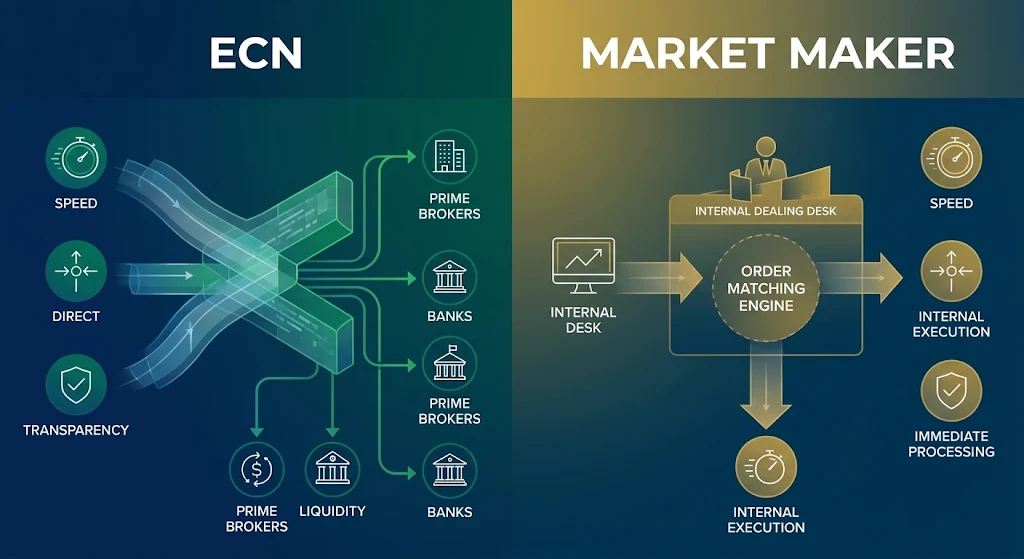
Not all brokers process your trades the same way. Understanding a broker’s execution model tells you whether your interests align with theirs.
1. Market Makers (Dealing Desk)
Market makers create their own internal market for clients. Instead of sending every retail order to the interbank market, they take the other side of your trade or offset client buy and sell orders internally.
- Pros: Often offer fixed spreads, low minimum deposits, and instant execution even during volatile periods.
- Cons: Potential conflict of interest if the broker profits when you lose, though top-tier regulated market makers manage risk responsibly.
2. STP (Straight Through Processing)
STP brokers route your orders directly to a pool of liquidity providers without human dealing-desk intervention. They earn money by adding a small markup to the spread provided by their liquidity partners.
- Pros: No dealing desk conflict of interest; variable spreads that tighten during high-liquidity sessions.
- Cons: Spreads can widen significantly during major economic news releases.
3. ECN (Electronic Communication Network)
ECN brokers connect you directly to an electronic network where banks, hedge funds, and other traders interact. You see raw interbank spreads (often starting at 0.0 pips on major pairs like EUR/USD) and pay a transparent, fixed commission per lot traded.
- Pros: Deepest liquidity, fastest execution, zero spread markup, ideal for high-volume traders.
- Cons: Requires paying commissions per round turn; usually requires a higher minimum deposit.
When choosing a forex broker, match the execution model to your strategy: market makers suit small accounts, while scalpers and day traders usually need an ECN or raw-spread account.
Trading Conditions That Impact Real Performance

Advertising banners often highlight “0.0 pip spreads,” but your true cost of trading involves several interacting factors:
- Spreads: The difference between the Bid (sell) and Ask (buy) price. Tighter spreads reduce your immediate entry cost.
- Commissions: On Raw or ECN accounts, expect to pay roughly $5 to $7 per standard lot round-trip in exchange for institutional spreads.
- Swap Fees (Overnight Financing): If you hold positions open past the daily market rollover (5:00 PM New York time), you either pay or earn interest based on the interest rate differential between the two currencies.
- Execution Speed & Slippage: Slippage occurs when your order fills at a slightly different price than requested due to fast-moving markets. Good brokers offer positive slippage (filling you at a better price when available) rather than only passing along negative slippage.
- Liquidity Depth: Deep liquidity ensures larger orders fill cleanly without triggering massive price jumps.
Account Types and Which Traders They Suit
Most reputable brokers offer multiple account tiers tailored to different account balances and strategies:
- Standard Account: Commission-free trading where all broker fees are built into a slightly wider variable spread (typically 1.0 to 1.5 pips on EUR/USD). Best for beginners and swing traders.
- Raw Spread / ECN Account: Offers institutional spreads starting near 0.0 pips plus a fixed commission per trade. Best for scalpers, day traders, and algorithmic strategies.
- Micro / Cent Account: Displays balances in cents rather than dollars (e.g., $50 shows as 5,000 cents). Ideal for beginners transitioning from a demo account to real-money emotional management without risking significant capital.
- Islamic (Swap-Free) Account: Removes overnight interest charges to comply with Sharia law, typically substituting an administrative fee if positions remain open beyond a set number of days.
Deposits, Withdrawals, and Broker Fees
Funding your account is usually instant, but withdrawing profits reveals a broker’s true operational integrity. Before depositing, check:
- Supported Payment Methods: Bank wire transfers, credit/debit cards, e-wallets (PayPal, Skrill, Neteller), and local payment rails.
- Processing Times: Reputable brokers process withdrawal requests within 24 to 48 business hours.
- Hidden & Non-Trading Fees: Watch out for high withdrawal fees, currency conversion markups when depositing in a different base currency, and inactivity fees charged if you don’t place a trade for 3 to 6 months.
Platforms, Tools, and Trading Experience
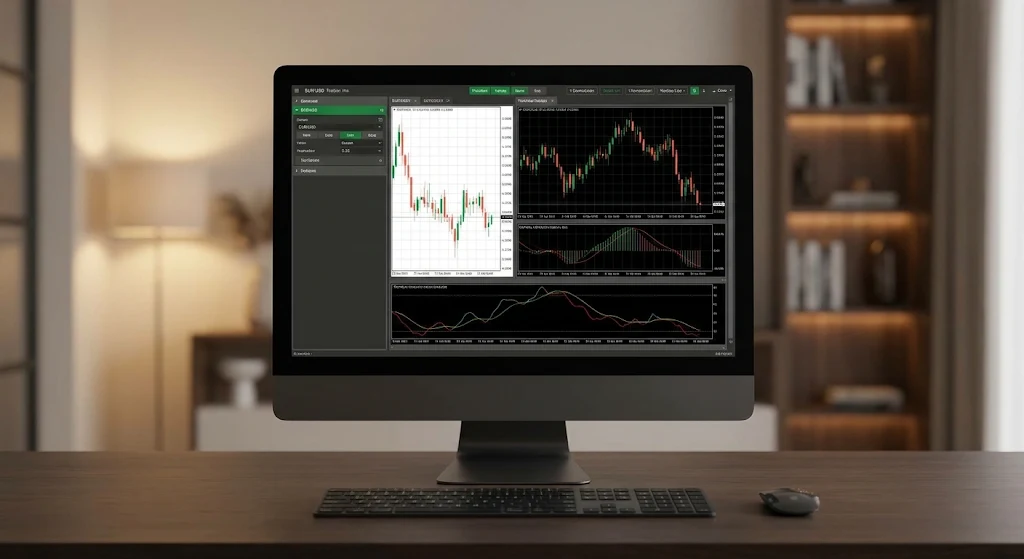
Your trading platform is your daily workspace, so ensure your broker supports software that matches your workflow:
- MetaTrader 4 (MT4): The industry classic—lightweight, reliable, and packed with custom indicators and Expert Advisors (EAs).
- MetaTrader 5 (MT5): Faster multi-threaded processing, built-in economic calendar, more timeframes, and access to multi-asset CFDs (stocks, indices, commodities).
- cTrader: Favored by ECN traders for its modern interface, Level II depth-of-market pricing, and advanced order management.
- TradingView Integration: Allows you to execute trades directly from TradingView’s industry-leading charts using your broker’s live account credentials.
Customer Support, Reputation, and Transparency
When a platform freezes during a high-impact news event or a deposit is delayed, responsive support is critical.
- Test their 24/5 live chat before funding an account—ask a technical question about margin call levels or swap rates to see how quickly and accurately they answer.
- Check independent trader communities and regulatory records for patterns of unresolved withdrawal complaints or regulatory fines.
How to Match a Broker to Your Trading Style
- Beginners: Prioritize Tier-1 regulation, low minimum deposits, micro-lot sizing (0.01 lots), and an intuitive platform with educational resources. Beginner Forex Guide
- Scalpers: Require an ECN/Raw Spread account, sub-50ms execution speeds, minimal slippage, and zero restrictions on placing stop-losses close to current market price.
- Day Traders: Need low all-in costs (tight spreads + low commissions) and reliable execution during the London and New York session overlaps.
- Swing & Position Traders: Focus less on 0.2-pip spread differences and much more on competitive swap rates and strong regulatory protection for larger account balances.
- Algorithmic / EA Traders: Look for MT4/MT5 or cTrader support, API access, and free or discounted VPS (Virtual Private Server) hosting to keep bots running 24/7.
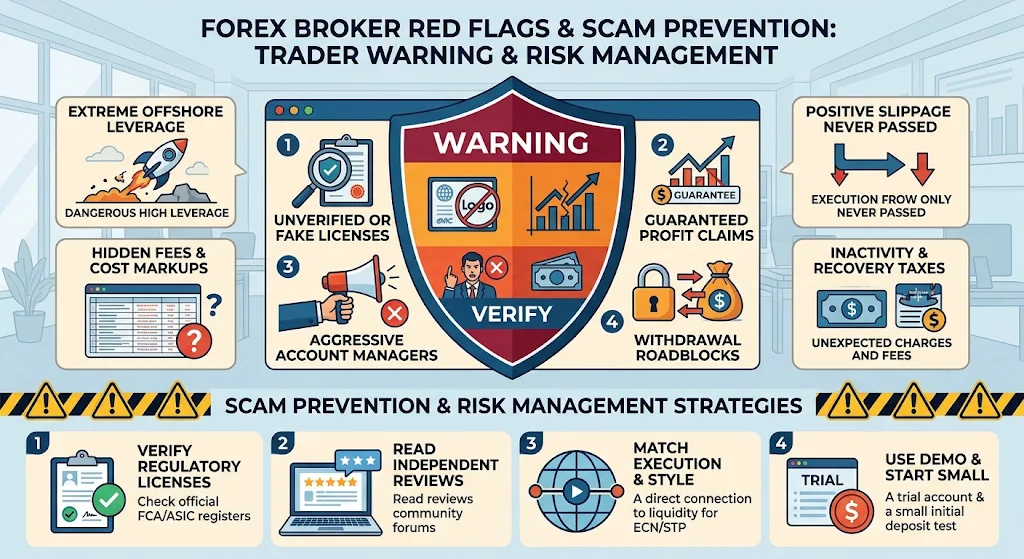
Common Broker Red Flags and How to Avoid Scams
Walk away immediately if you spot any of these warning signs:
- Guaranteed Profit Claims: No legitimate broker promises consistent returns or manages accounts with guaranteed yields.
- Unverified or Fake Licenses: Claiming regulation without a verifiable license number on the regulator’s official website.
- Aggressive Account Managers: High-pressure phone calls urging you to deposit more money or take oversized positions.
- Withdrawal Roadblocks: Requiring you to pay extra “taxes” or “unlocking fees” before releasing your own account balance.
- Extreme Offshore Leverage: Offering 1:2000 or 1:3000 leverage with no negative balance protection—a recipe for instant account wipeouts.
Step-by-Step Process for Choosing Your Broker
- Define Your Requirements: Identify your starting capital, preferred trading style, and desired platform.
- Shortlist Tier-1 / Tier-2 Brokers: Select 3 to 4 brokers regulated in your jurisdiction.
- Verify Licenses: Cross-check their registration numbers directly on the official regulator databases.
- Compare Total Costs: Calculate the combined spread + commission + swap rates for your primary currency pairs.
- Test on a Demo Account: Open a free demo account with each finalist to test execution speed, platform stability, and spreads during active market hours.
- Start Small: Fund a live account with a small test deposit, place a few micro-lot trades, and complete a small test withdrawal before committing your full trading capital.
If you would rather trade a simulated funded account than your own capital, see how the evaluation rules work in our FundingPips review.
Final Checklist Before Opening an Account
Use this checklist as the last step in how to choose a forex broker. If you cannot tick every box, keep looking.
- Regulated by a reputable Tier-1 or Tier-2 financial authority
- License number verified on the official regulator register
- Client funds held in segregated tier-1 bank accounts
- Negative balance protection included
- Execution model (ECN/STP/Market Maker) matches your strategy
- Transparent spreads, commissions, and swap rates
- Fast, fee-free deposit and withdrawal methods supported
- Responsive customer support tested via live chat
The best way to choose a forex broker is to put safety first, then compare total trading costs and test the platform on a demo account before funding it. A broker that fits your strategy and is properly regulated will serve you better than one with the loudest bonus offer.
Trading leveraged products carries a high risk of loss. Nothing on this page is financial advice.
Frequently Asked Questions
How do I choose a forex broker as a beginner? Start with regulation by a Tier-1 authority such as the FCA or ASIC, then look for low minimum deposits, micro-lot sizing and a demo account.
What is the most important factor when picking a forex broker? Regulation and client-fund protection come first, because spreads and platform features don’t matter if you can’t withdraw your money.