.
Daily Drawdown vs Maximum Drawdown: Key Differences Every Trader Should Know
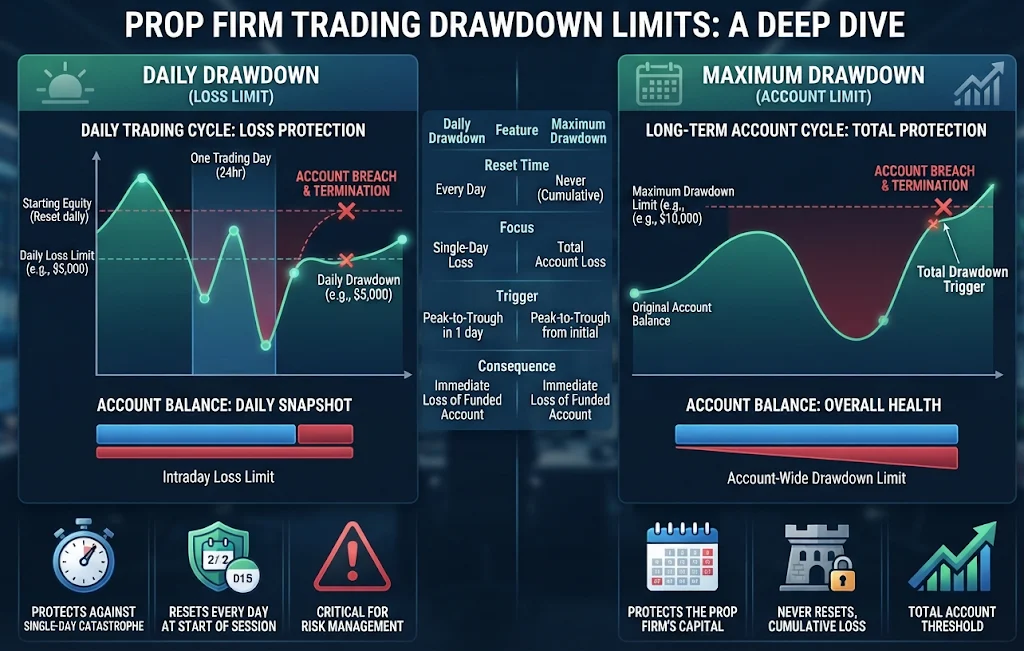
Understanding prop firm drawdown rules is one of the most important parts of successful funded trading. Many traders focus heavily on profit targets, trading strategies and account growth, yet fail to challenge themselves because they misunderstand how loss limits work.
Two of the most common rules imposed by proprietary trading firms are the daily loss limit and the overall account limit. Most traders know them as daily drawdown and maximum drawdown. The terms sound similar, but they serve different purposes and are calculated differently.
Failing to understand the difference between daily and maximum drawdown can lead to unnecessary challenge failures, account violations and lost funding opportunities.
In this guide, we explain how each limit works, how comparing short-term and long-term drawdown limits makes your risk planning clearer, and how traders can manage both effectively.
If you’re new to funded trading, start with our Prop Firm Trading Hub to understand challenges, risk management, and funded account requirements.
What Is Drawdown?
Drawdown measures the decline in account value from a previous high point.
In proprietary trading, loss limits are used to control risk and protect capital. They help ensure traders maintain discipline rather than exposing accounts to excessive losses.
These rules are not designed to restrict profitable traders. Instead, they encourage consistency and professional risk management practices.
Most prop firms apply account protection rules at two levels: a limit for each trading day and a limit for the account as a whole.
What Is Daily Drawdown?
A daily drawdown, also called a daily loss limit, is the maximum amount a trader can lose within a single trading day.
Once the intraday loss limit is reached, trading privileges may be restricted, or the challenge may be terminated, depending on the firm’s rules.
A daily risk threshold is designed to stop traders from taking impulsive actions after losing trades.
Example of a Daily Loss Limit
Imagine a trader begins the day with:
- Account balance: $100,000
- Daily loss limit: 5%
The maximum permitted loss for the day would be:
$100,000 × 5% = $5,000
If the account falls below $95,000 during the trading day, the trader may violate the rule and fail the evaluation.
Why the Daily Loss Limit Matters
A daily account loss cap exists to encourage disciplined behaviour.
It helps prevent:
- Revenge trading
- Emotional decision-making
- Excessive position sizing
- High-risk recovery attempts
For many traders, the daily trading loss allowance is the first rule breached during a challenge. Understanding drawdown limits is essential for anyone attempting a prop firm challenge.
What Is Maximum Drawdown?
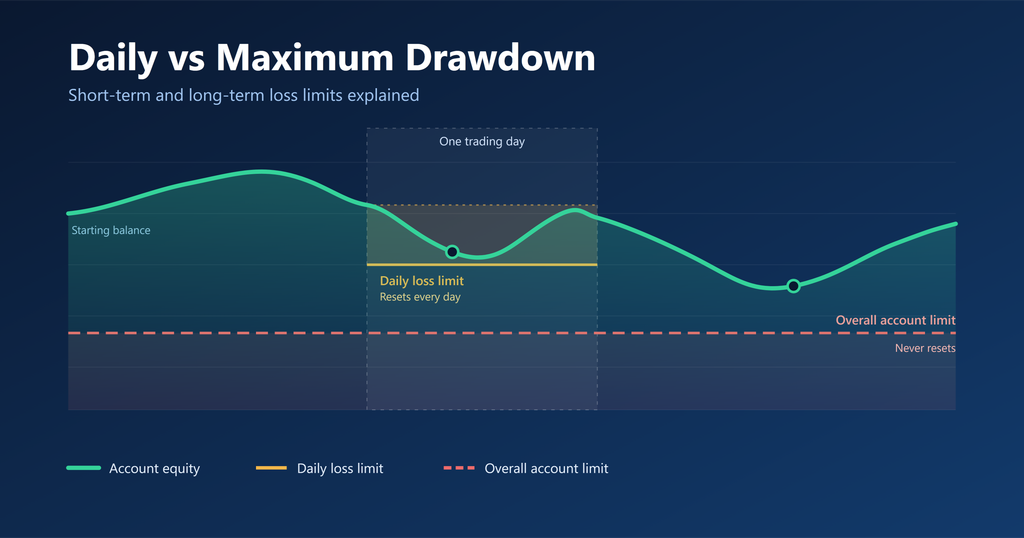
Maximum drawdown, or the total account loss limit, is the largest overall decline an account can experience before a challenge or funded account is terminated.
Unlike the daily limit, it applies across the entire evaluation period rather than a single trading session.
It acts as a long-term risk control mechanism.
Example of an Overall Account Limit
Consider:
- Account balance: $100,000
- Overall account limit: 10%
The account cannot fall below:
$90,000
Regardless of how long the challenge lasts.
Even if no single trading day exceeded the intraday loss limit, a series of losses over time could eventually breach the account-wide drawdown limit.
Why the Overall Account Limit Matters
This account protection limit shields firms from sustained account deterioration.
It also ensures traders maintain consistent performance rather than relying on aggressive recovery strategies.
Daily Drawdown vs Maximum Drawdown
The easiest way to see the difference between daily and maximum drawdown is to compare their purpose.
| Rule | Daily loss limit | Overall account limit |
|---|---|---|
| Timeframe | Single day | Entire account |
| Purpose | Limit short-term losses | Limit long-term losses |
| Resets daily? | Yes | No |
| Risk focus | Daily discipline | Account survival |
| Common cause | Revenge trading | Ongoing poor risk management |
While both rules are designed to protect capital, understanding the difference between short-term and long-term loss limits can significantly improve challenge performance.
Although both rules limit losses, they address different aspects of trader behaviour.
The daily loss limit controls what happens today.
The overall account limit controls what happens over the life of the account.
Which Rule Causes More Traders to Fail?
At many prop firms, breaching the daily loss limit is among the most common reasons traders fail evaluations.
This often occurs because traders:
- Increase position size after losses
- Chase missed opportunities
- Attempt to recover losses too quickly
- Ignore trading plans
Breaches of the overall account limit typically develop more gradually and often result from poor risk management habits rather than a single bad day.
Both rules require equal attention.
Fixed Drawdown vs Trailing Drawdown
Some prop firms use a trailing drawdown instead of a fixed one.
Fixed Drawdown
A fixed drawdown level remains unchanged throughout the challenge.
Example:
- Starting account: $100,000
- Overall account limit: 10%
- Maximum loss allowed: $10,000
The account cannot fall below $90,000.
Trailing Drawdown
A trailing drawdown moves upward as account equity increases.
For example:
- Initial account: $100,000
- Drawdown limit: $10,000
If the account grows to $110,000, the drawdown threshold may also move higher.
This creates additional pressure on traders to protect newly earned profits.
Understanding whether a firm uses fixed or trailing loss limits is critical when evaluating challenge requirements.

How Professional Traders Manage Drawdown
Successful traders rarely focus solely on profits.
Instead, they focus on controlling risk. According to Investopedia, a drawdown measures the decline of an investment or trading account from a peak to a trough.
Use Consistent Position Sizing
Avoid risking significantly different amounts between trades.
Consistency helps prevent sudden account volatility.
Define Risk Before Entering a Trade
Always know how much capital is at risk before opening a position.
This prevents emotional decision-making during market volatility.
Limit Losses Per Trade
Many experienced traders risk only a small portion of account capital on each setup.
Follow a Trading Plan
A written trading plan provides structure and reduces impulsive behaviour.
Maintain a Trading Journal
Tracking performance helps identify recurring patterns and opportunities for improvement.
Common Drawdown Mistakes
Overtrading
Entering too many positions often increases exposure and risk.
Moving Stop Losses
Widening stop losses can quickly increase drawdown.
Chasing Losses
Attempting to recover losses immediately often leads to larger violations.
Ignoring Risk-to-Reward Ratios
Poor reward expectations can lead to inconsistent long-term performance.
Risking Too Much Per Trade
Even strong strategies can fail when position sizes become excessive.
How Drawdown Rules Support Better Trading
Many traders initially view trading loss limits as restrictions. Effective risk management remains one of the most important skills for preserving trading capital.
In reality, they often encourage the habits that contribute to long-term trading success.
These account protection rules help traders:
- Preserve capital
- Develop patience
- Improve consistency
- Reduce emotional decision-making
- Focus on quality setups
Learning to operate within these limits can ultimately strengthen trading performance.
Frequently Asked Questions
Does the daily loss limit reset every day?
In most cases, yes. However, firms differ on the reset time and on whether the limit is measured on balance or equity, so always review the specific rules of your prop firm.
Can I breach the overall account limit without hitting the daily limit?
Yes. Multiple losing days that each stay within the daily limit can still lead to a breach of the account-wide limit.
Which drawdown rule is more important?
Both are critical. The daily limit protects short-term performance, while the overall limit protects account survival.
Are drawdown rules used on funded accounts?
Most prop firms continue applying loss limits after traders receive funding.

Related Resources
- Prop Firm Trading Hub
- What Is a Prop Firm Challenge?
- Prop Firm Risk Management Rules
Final Thoughts
Daily and maximum drawdown are two of the most important risk management concepts in proprietary trading.
While the daily loss limit caps losses within a single trading day, the overall account limit protects the account over the long term. Understanding how both rules work can help traders avoid unnecessary violations and improve their chances of keeping a funded account.
Ultimately, successful prop firm traders focus less on chasing profits and more on protecting capital. Consistent risk management remains one of the strongest predictors of long-term trading success.