The5ers Review 2026: Programs, Rules, Scaling and Who It Suits
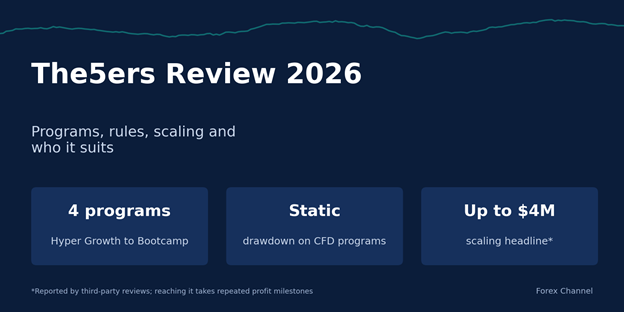
By Forex Channel · Last checked 11 November 2026. This The5ers review uses The5ers’ published terms as reported by third-party summaries. Confirm every figure before you pay.
This The5ers review covers the four main programs, the trading limits, fees and refund rules, the strengths and weaknesses, and the kind of trader the firm suits best.
The5ers is a prop trading firm that evaluates traders and gives passing traders a funded account, with a profit share and a scaling plan that can grow the account over time. It is often described as a good fit for patient, consistent traders rather than people chasing fast gains. That is only part of the picture: the programs differ a lot, and the rules that matter most depend on which one you choose.
Forex Channel Verdict
Overall rating: 8.6/10
Best for
- Consistent traders focused on long-term growth and disciplined risk management
- Swing, position and low-frequency traders
- Traders who value scaling over a fast first payout
Not ideal for
- Traders who want a high profit split from day one
- Aggressive traders who need rapid account growth
Bottom line: In this The5ers review, the firm stands out for its static drawdowns, program choice and a scaling plan that rewards steady results. The low starting profit split on some programs and the payout fee are the main costs, and both depend on the program.
What Is The5ers?
The5ers sells access to an evaluation. You trade toward a profit target inside set loss limits. If you succeed, you receive a funded account and can request a share of the profits under the firm’s terms. “Funded” does not mean you control a pool of live capital with your own money, and the fee is the cost of the evaluation, not an investment with a predictable return.
The5ers Programs at a Glance
| Hyper Growth | High Stakes | Bootcamp | Pro Growth | |
| Steps | One | Two | Three | One |
| Profit target | 10% | 8% then 5% (Classic); 10% then 5% (New) | 6% per step | 10% |
| Max loss | 6%, static | 10% (Classic); 8% (New, reported) | 4-5% | Varies by source |
| Daily loss | 3% daily pause | 5% (Classic); 4% (New, reported) | None reported by most sources | Varies by source |
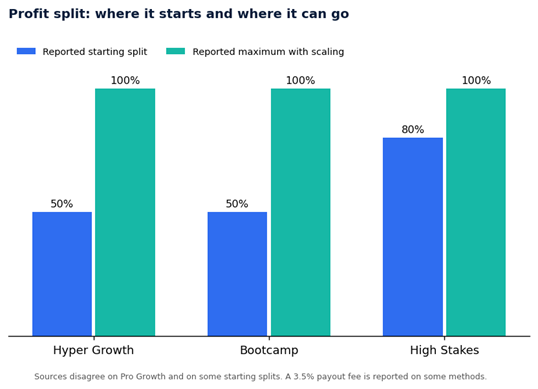
| Starting profit split | 50% (one source: ~80%) | 80% | 50% | 50% (one source: fixed 75%) |
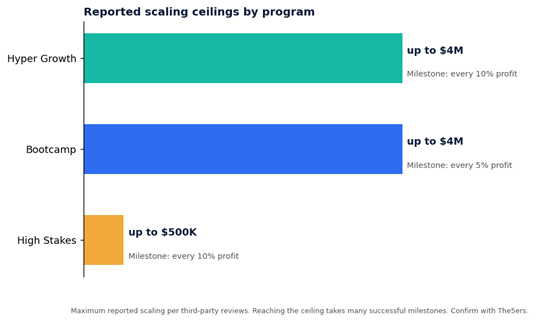
| Scaling | Account grows with each 10% profit, up to about $4M | Scales at each 10% milestone, up to about $500K | Scales with each 5% profit, up to about $4M | Check official terms |
| Fee refund | Reported non-refundable (one source disagrees) | Reported 70% of fee back with first payout | Reported non-refundable | Check official terms |
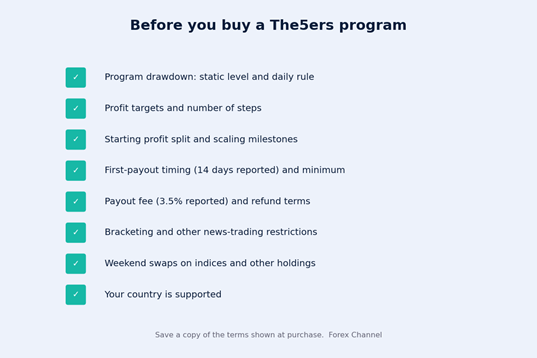
Sources disagree on several figures, and The5ers changes its programs over time. Treat the table as a guide and verify every number on The5ers’ official pages before you buy.
Hyper Growth
Hyper Growth is a one-step route. You aim for a 10% target with a 6% static maximum loss and a 3% daily limit. Reviews describe the daily limit as a pause rather than a permanent fail on this program, but check how it applies to your account. The scaling plan is the main draw: the account can grow as you reach profit milestones, with a reported ceiling of around $4 million.
The 6% drawdown is tighter than some rivals, and the starting split is reported at 50%. This program suits traders with a controlled, low-risk strategy.
High Stakes
High Stakes is a two-step evaluation. The Classic version is reported at 8% then 5% targets, a 10% maximum loss and a 5% daily limit. A newer version is reported at 10% then 5%, with 8% and 4% limits. It reportedly starts at an 80% profit split and requires a minimum number of profitable days. It is the most conventional route and the one with the best reported fee refund.
Bootcamp
Bootcamp breaks the evaluation into three steps with a 6% target each, a small drawdown of 4-5% and, per most sources, no daily loss limit. It suits traders who want to prove a repeatable approach in small stages. The reported starting split is 50%.
Scaling, Profit Split and Payouts
Scaling is the feature that defines The5ers. Reviews report that funded accounts grow as you hit profit milestones, and the profit split rises with them toward a reported 100%. The headline $4 million ceiling takes many successful milestones, and one reviewer calls it marketing rather than a realistic plan for most traders.
- First payout: reported at 14 days after the funded account is activated, with a minimum of $150 after the split.
- Payout cycle: about every two weeks, with the clock reset when the account scales.
- Payout fee: 3.5% is reported on some methods such as Rise, crypto and bank transfer, plus any receiving-bank fees.
- Hub Credit: some programs earn credit that cannot be withdrawn as cash.
Price, Refunds and Accessibility
What it costs
The5ers charges a one-time fee per program, with no monthly subscription. Price depends on the program and account size. Check the current price at checkout rather than relying on a review.
Refunds
- High Stakes: reported refund of 70% of the fee with your first payout, needing at least $150 profit and a funded account active for 14 days.
- Hyper Growth and Bootcamp: reported as non-refundable, although one source disagrees.
- Before trading: a refund window of 5 to 14 days is reported if you have not started trading. Sources disagree on the length.
- Failed evaluation: the fee is not returned.
Refund terms change. Confirm the rule for your exact program and keep a copy of what was shown at checkout.
Accessibility
- Check the available platforms, markets and leverage at checkout. Hyper Growth is reported at up to 1:100.
- Check that your country is supported before paying.
The5ers Risk Rules in Practice
- Drawdown is reported as static on the CFD programs, so the loss level does not trail your balance.
- Weekend and overnight holding is reported as allowed. Indices held over the weekend can carry high swaps.
- News trading is reported as allowed, but bracketing, meaning buy and sell stop orders placed around a release, is reported as prohibited.
- Consistency is not reported as a formal rule, but some programs require a minimum number of profitable days.
For disciplined traders, these rules provide structure. For traders who size up after losses, they become a hard limit.
Advantages of The5ers
- Flexible programs. One-, two- and three-step routes suit different styles.
- Static drawdown. The loss level does not trail your balance on the CFD programs.
- Scaling. Account and profit split can grow with results.
- Fit for swing traders. Weekend holding is reported as allowed.
- Focus on consistency. The model rewards steady performance over fast gains.
Potential Drawbacks
- Lower starting split. Two programs are reported to begin at 50%.
- Payout fee. A 3.5% fee is reported on some methods.
- Tight drawdown. Hyper Growth’s 6% limit is tighter than some competitors.
- Headline claims. The $4 million ceiling and 100% split take many milestones.
- Details change. Programs differ and third-party summaries can be out of date.
- Less well known than FTMO. Smaller community and brand recognition.
Who The5ers Is Best For
Based on this The5ers review, The5ers suits:
- Beginners with proven risk discipline
- Swing and position traders
- Part-time traders with limited screen time
- Consistent traders focused on gradual growth
Who Should Consider Alternatives
Highly aggressive traders who want rapid account growth, or a high profit split from the first payout, may prefer firms with different evaluation structures. New traders still learning risk management may do better practising on a demo account first.
The5ers vs FTMO
The5ers and FTMO are both well-known names that tend to appeal to different traders. FTMO is built around fixed targets and a large community. The5ers puts more weight on scaling and consistency, and offers more program variety.
| Comparison point | The5ers | FTMO |
| Programs | Hyper Growth, High Stakes, Bootcamp, Pro Growth | 1-Step and 2-Step |
| Growth path | Scaling plan with a reported ceiling of up to about $4M | Check FTMO’s current scaling terms |
| Starting split | 50% to 80% depending on program | Check FTMO’s current terms |
| Costs | One-time fee; refund differs by program | One-time fee; refund rules differ by model |
Neither is universally better. Compare the current official rules on drawdown, targets, split, fees and refunds before choosing.
How to Choose and Trade Carefully
Start with your own trade log. Measure your average daily return, worst drawdown and how long you hold trades. Then match those numbers to a program’s targets and limits. Size positions from the loss limit, not the profit target, and do not increase size to recover losses.
The5ers Review: Final Verdict
Our The5ers review concludes that the firm is a good option for patient, disciplined traders, especially swing and part-time traders who value scaling over a fast start. Its static drawdowns and program choice make it one of the more trader-friendly structures. It is less suited to traders who want a high split from day one or rapid growth.
We rate The5ers 8.6/10 in this The5ers review: strong on structure and scaling, marked down for low starting splits on some programs, the payout fee and headline claims that take time to reach.
Before paying, review The5ers’ current terms, check regional availability and risk only an evaluation fee you can afford to lose.
Trading carries a high risk of loss. Evaluation and simulated accounts do not guarantee live-market performance or payouts. Nothing on this page is financial advice.
Frequently Asked Questions
- Is The5ers legitimate? It operates as a prop firm with published terms and many customer reports. That is not a guarantee of payouts. Read the contract and check recent independent reports.
- Does The5ers allow news trading? Reported as allowed, but bracketing is reported as prohibited.
- Can you hold trades over the weekend? Reported as allowed. Check swaps on indices.
- When is the first payout? Reported at 14 days after the funded account is activated, with a $150 minimum.
- Can I lose money? Yes. You can lose the evaluation fee, and payouts are never guaranteed.
Sources
- The5ers Review 2026 (FXEmpire)
- The 5ers Rules 2026: Bootcamp and Hyper Growth (TradingFinder)
- The5ers Review 2026: Rules, Scaling & Payouts (Traders Second Brain)
- The5ers Review 2026: Payouts, Rules & Profit Split (Tradelytic)
- The5ers Review 2026: Programs, Rules, Payouts (Velotrade)
- The5ers Rules, Challenges & Pass Rate (LuxAlgo)
- The5ers Review 2026: Programs, Fees and Payout Terms (CryptoSlate)
- The5ers Rules (2026): Drawdown, News, Payouts (Pipster)
- The5%ers Payout Guide (PropNavi)