
How to Build a Forex Trading Plan That Actually Works. Why Every Trader Needs a Written Trading Plan
A trading plan is the difference between reactive traders and consistent traders. Without a plan, emotions take over. With a plan, decisions become systematic.
A proper forex trading plan:
- Removes guesswork
- Reduces emotional trading
- Creates consistency
- Helps you measure performance
- Protects your capital
Most traders fail not because their strategy is bad — but because they have no structure. This guide gives you a complete blueprint to build a forex trading plan that actually works.
Define Your Trading Goals and Style
Before you choose a strategy, you must define who you are as a trader.
1. Day Trading
- Trades last minutes to hours
- Requires fast decision‑making
- Best for traders who can monitor charts actively
2. Swing Trading
- Trades last days to weeks
- Less screen time
- Ideal for traders with full‑time jobs
3. Position Trading
- Long‑term trades
- Based on fundamentals and macro trends
- Minimal chart monitoring
Your forex trading plan must match your lifestyle — not the other way around.
Define Your Entry and Exit Rules
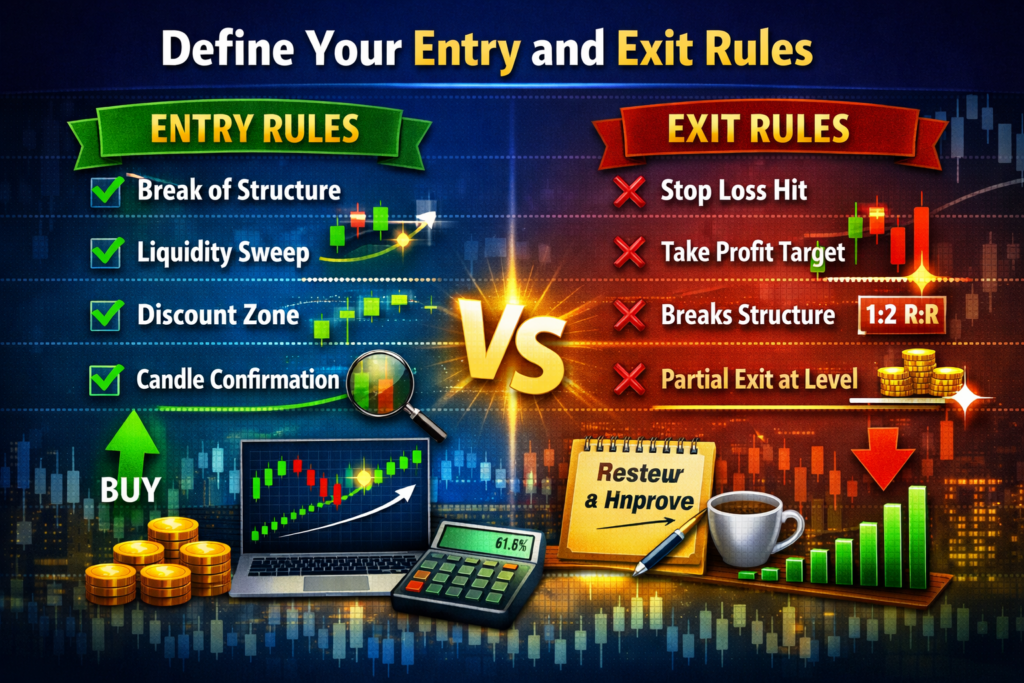
Your forex trading plan must clearly state when you enter and when you exit a trade. No vague language. No “I’ll see how it looks.”
Entry Rules
Examples:
- Market structure must be trending
- BOS or CHOCH must be confirmed
- Price must be in premium/discount zone
- Liquidity sweep must occur before entry
- Candle confirmation required
Exit Rules
Examples:
- Stop loss below/above structure
- Take profit at next liquidity pool
- Exit if structure breaks against your direction
- Exit partials at key levels
Your rules should be so clear that another trader could follow them without asking questions.
Risk Management Rules
This is the heart of your trading plan. A good strategy with bad risk management still loses money.
Position Sizing
Decide your risk per trade:
- 0.5%
- 1%
- 2% (aggressive)
Consistency is key — don’t change risk randomly.
Stop Loss Placement
Your plan should specify:
- Structure‑based stops
- Volatility‑based stops
- ATR‑based stops (optional)
Never place stops based on “what feels right.”
Maximum Daily/Weekly Loss
Examples:
- Stop trading after 3 losses
- Stop trading after 3% daily drawdown
- Weekly max loss: 6%
This prevents emotional spirals.
Trade Journaling and Performance Tracking
A trading plan is useless without tracking.
Your journal should include:
- Date & time
- Pair traded
- Entry reason
- Screenshot before entry
- Screenshot after exit
- Emotions felt
- What you did well
- What you must improve
Over time, patterns emerge — both good and bad.
Performance Metrics to Track
- Win rate
- Average R:R
- Monthly return
- Maximum drawdown
- Most profitable setups
- Most common losing mistakes
This is how traders evolve.
How to Review and Improve Your Plan
Your trading plan is a living document. It should evolve as you gain experience.
Weekly Review
- Identify mistakes
- Identify winning patterns
- Adjust rules if needed
Monthly Review
- Evaluate performance
- Remove setups that don’t work
- Strengthen setups that do
Quarterly Review
- Rebuild your plan with new insights
- Update risk rules
- Refine your strategy
Professional traders constantly refine their edge — you should too.
Example Trading Plan Template
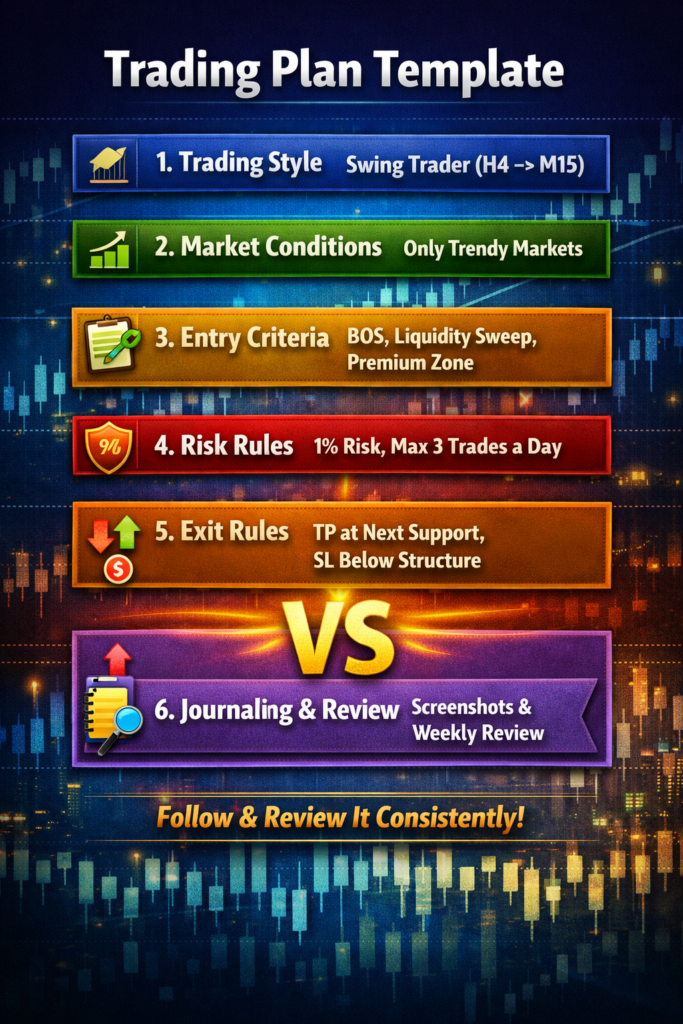
Here’s a simple structure you can copy:
1. Trading Style:
Swing trader (H4 → M15 execution)
2. Market Conditions:
Trade only trending markets with clean structure.
3. Entry Criteria:
- BOS or CHOCH confirmed
- Liquidity sweep
- Price in premium/discount
- Candle confirmation
4. Risk Rules:
- 1% per trade
- Max 3 trades per day
- Stop after 3 losses
5. Exit Rules:
- TP at next liquidity pool
- SL below/above structure
- Partial at 1:2 R:R
6. Journaling:
Screenshot before/after Emotion notes Mistake tracking
7. Review Schedule:
Weekly + monthly performance review
This template gives you structure without overcomplicating your process.
Final Thoughts
A trading plan is your anchor. It keeps you disciplined when emotions try to take over. It gives you clarity when the market becomes chaotic. And most importantly — it turns trading from gambling into a structured business.
Build your plan. Follow it. Refine it. That’s how consistency is created.
Learn more from the Links below.
- Learn Forex → Risk Management Basics
- Psychology → Discipline in Trading
- Tools → Forex Journaling Tools