Prop Firm Trading Hub: Your Complete Guide to Funded Trading

The world of proprietary trading has transformed significantly over the past decade. What was once reserved primarily for institutional traders has become accessible to retail traders through modern prop firms that offer funded trading opportunities. These firms provide traders with access to larger amounts of capital, allowing them to scale strategies without risking substantial personal funds.
For aspiring traders, prop firms can provide an attractive pathway to trading larger accounts and building a trading career. However, success requires a clear understanding of evaluation processes, risk management requirements, and the psychological discipline needed to operate within strict trading parameters.
This Prop Firm Trading Hub serves as a central resource for understanding how proprietary trading works, how funded accounts are earned, and what traders can do to increase their chances of long-term success.
Why Traders Choose Prop Firms
One of the biggest barriers facing retail traders is access to capital. Even skilled traders can struggle to grow a small account because position sizes are limited by account balance. Prop firms solve this problem by offering funded accounts that allow traders to control larger amounts of capital without depositing large sums of their own money.
Many traders are attracted to prop firms because the potential returns can be significantly higher than trading a personal account of a similar size. Instead of risking thousands of pounds or dollars upfront, traders pay an evaluation fee and attempt to meet the firm’s performance objectives.
Prop firms also encourage structured risk management. Funded traders must follow strict rules regarding daily drawdown limits, maximum drawdown thresholds, and overall account preservation. These requirements help traders develop discipline and consistency rather than relying on aggressive gambling-style approaches.
For aspiring professionals, prop firms can provide a pathway to trading larger capital while learning valuable risk management skills. However, success still depends on maintaining a profitable strategy, following all challenge requirements, and preserving capital over the long term.
What Is a Prop Firm?
A proprietary trading firm, commonly referred to as a prop firm, is a company that provides capital to traders in exchange for a share of the profits they generate. Rather than trading their own personal funds, traders operate using the firm’s capital while adhering to predefined risk management rules.
Traditional proprietary trading firms typically employed traders directly and provided extensive training, technology, and infrastructure. Modern retail-focused prop firms have introduced a different model, allowing independent traders to demonstrate their skills through evaluation programs before receiving access to funded accounts.
This approach has expanded opportunities for retail traders who possess trading skills but may lack significant capital.
How Prop Firms Make Money
Most prop firms generate revenue through a combination of challenge fees and profit-sharing arrangements. Traders pay evaluation fees to participate in funding assessments, while successful traders share a percentage of future profits with the firm.
Because the firm’s business model depends on managing risk effectively, strict rules are applied throughout both the evaluation and funded stages.
How Prop Firm Challenges Work – Prop Firm Trading Hub
Before receiving a funded account, traders are generally required to complete an evaluation process often referred to as a prop firm challenge.
The purpose of the challenge is not simply to determine whether a trader can generate profits. Instead, it is designed to assess consistency, discipline, and risk management under real market conditions.
Typical challenge requirements include:
- Achieving a specified profit target
- Staying within daily drawdown limits
- Staying within maximum drawdown limits
- Following minimum trading day requirements
- Adhering to the firm’s trading rules
Upon successful completion of all requirements, traders may qualify for a funded account and become eligible for profit-sharing payouts.
Many traders mistakenly focus exclusively on reaching profit targets, but risk management violations are often the primary reason challenges fail.
Related Reading: What Is a Prop Firm Challenge?
Understanding Prop Firm Drawdown Rules
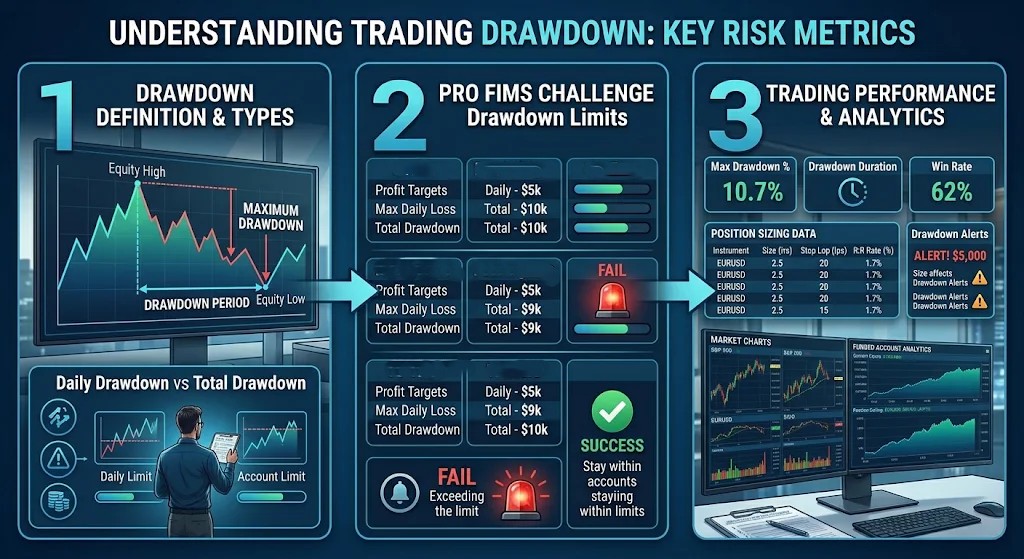
Drawdown management is one of the most important concepts in funded trading. Even profitable traders can lose funding if drawdown rules are breached.
Daily Drawdown
Daily drawdown limits restrict how much loss a trader can incur during a single trading day. This rule helps prevent impulsive decision-making and excessive risk-taking following losing trades.
Daily limits encourage traders to preserve capital after reaching a predetermined loss threshold.
Maximum Drawdown
Maximum drawdown represents the largest decline an account can experience before funding is terminated. Unlike daily drawdown limits, maximum drawdown is tracked across the entire account.
This rule ensures traders maintain long-term consistency rather than relying on high-risk recovery strategies.
Why Drawdown Rules Matter
Prop firms operate as risk management businesses. Their objective is not merely to find profitable traders but to identify traders who can protect capital consistently.
Understanding the relationship between daily drawdown and maximum drawdown is essential for long-term funded account success.
Related Reading: Daily Drawdown vs Maximum Drawdown
Essential Prop Firm Risk Management Rules
Consistent profitability begins with effective risk management.
Many successful traders focus more on controlling losses than maximising gains. This mindset aligns closely with how prop firms evaluate performance.

Position Sizing
Position sizing determines how much exposure is taken on each trade. Proper sizing helps traders remain within drawdown limits while maintaining consistency.
Risk Per Trade
Many experienced funded traders risk only a small percentage of account equity on any individual position. This approach reduces the likelihood of significant account damage from a single losing trade.
Exposure Management
Avoiding excessive exposure to correlated positions can help manage overall account risk and reduce volatility.
Consistency Requirements
Some firms evaluate trading consistency alongside profitability. Large fluctuations in trade size or overly aggressive risk-taking may indicate poor discipline.
A professional trader approaches every trade with a structured risk framework.
Related Reading: Prop Firm Risk Management Rules
Why Most Traders Fail Prop Firm Challenges
Despite possessing technical knowledge of markets, many traders struggle to pass prop firm evaluations.
Overtrading
Overtrading often occurs when traders feel pressure to reach profit targets quickly. This can lead to unnecessary entries, increased risk exposure, and emotional decision-making.
Poor Risk Management
Many challenge failures occur because traders focus on profits rather than preserving capital. A single poorly managed trade can result in a rule violation.
Emotional Trading
Fear, greed, frustration, and impatience can negatively influence decision-making. Emotional reactions often lead traders to abandon otherwise effective trading plans.
Lack of Preparation
Entering a challenge without a documented strategy or tested risk management approach often creates avoidable mistakes.
How to Increase Your Chances of Getting Funded
While there is no guaranteed path to success, several principles consistently separate successful traders from unsuccessful ones.
Create a Trading Plan
A written trading plan provides structure and helps maintain discipline during both winning and losing periods.
Focus on Process Rather Than Profit
Professional traders prioritise execution quality, risk control, and consistency over short-term financial outcomes.
Protect Capital First
Capital preservation should always take priority over aggressive growth. Traders who survive difficult market conditions place themselves in a position to capitalise on future opportunities.
Maintain a Trading Journal
Recording trades, emotions, and performance metrics helps identify recurring strengths and weaknesses.
Stay Patient
Prop firm evaluations reward disciplined decision-making more than aggressive trading. Patience remains one of the most valuable competitive advantages a trader can develop.
Frequently Asked Questions
Are prop firms worth it?
For traders with proven strategies and disciplined risk management, prop firms can provide access to significantly larger trading capital than might otherwise be available.
Can beginners pass prop firm challenges?
Beginners can pass challenges, but success rates generally improve when traders first develop consistent trading processes and risk management habits.
How do funded accounts work?
Funded accounts allow traders to trade using firm capital while receiving a percentage of profits generated according to the firm’s profit-sharing agreement.
Why do traders lose funded accounts?
The most common reasons include violating drawdown limits, poor risk management, overtrading, and emotional decision-making.
Is risk management more important than strategy?
Even strong trading strategies can fail when risk is not controlled properly. Long-term success typically depends on balancing a profitable methodology with disciplined risk management.

Common Mistakes That Cause Traders to Fail Prop Firm Challenges
A large percentage of traders fail prop firm evaluations, not because their strategy is unprofitable, but because they break the firm’s risk management rules. Understanding the most common mistakes can increase the likelihood of passing a challenge and keeping a funded account.
Overleveraging is one of the biggest causes of failure. Many traders increase position sizes in an attempt to reach profit targets quickly. While this can generate short-term gains, it also increases the risk of breaching daily drawdown limits.
Another common mistake is revenge trading after a loss. Instead of following a trading plan, traders may enter impulsive positions to recover losses, often creating even larger drawdowns.
Many traders also underestimate the importance of understanding challenge rules. Each prop firm may have different requirements regarding news trading, holding positions overnight, minimum trading days, or maximum risk exposure. Ignoring these rules can result in account violations even when trades are profitable.
A lack of consistency is another frequent issue. Some traders perform well for several days but abandon their strategy after experiencing a temporary drawdown. Prop firms generally reward disciplined execution and steady performance rather than sporadic high-risk gains.
The most successful funded traders focus on protecting capital first and generating profits second. By maintaining strict risk controls, following a proven strategy, and respecting challenge guidelines, traders place themselves in a stronger position to achieve long-term funding success.
Frequently Asked Questions About Prop Firm Trading
Can beginners join a prop firm?
Yes. Most prop firms allow beginners to participate in evaluation programs. However, new traders should develop a trading strategy and strong risk management habits before attempting a funded challenge.
How much money can funded traders make?
Earnings vary depending on account size, profit-sharing arrangements, and trading performance. Most firms distribute a percentage of profits to successful traders.
Are prop firm challenges difficult?
Challenges are designed to evaluate discipline, consistency, and risk management. Many traders fail because they breach drawdown limits rather than because their strategy is ineffective.
Do prop firms use real money?
Some firms fund traders with live capital after they pass an evaluation, while others may operate using simulated environments combined with profit-sharing models.
What is the most important prop firm rule?
Risk management is usually the most important factor. Daily drawdown and maximum drawdown limits are common requirements across most prop firms.
Explore Related Prop Firm Guides
Final Thoughts
Prop firms have created new opportunities for traders seeking access to larger capital without significant personal investment. However, successful funded trading requires more than the ability to identify market opportunities.
Understanding challenge requirements, respecting drawdown limits, implementing robust risk management practices, and maintaining emotional discipline are all essential components of long-term success.
Use this hub as your starting point for understanding proprietary trading and exploring the resources that can help you develop into a more consistent and professional trader.