.
FundingPips Review: An Independent Overview of Account
Models, Payout Rules and Trading Limits

By Forex Channel · Last checked 9 November 2026. Prop-firm rules change often, so confirm every figure against FundingPips’ current terms before you pay.
Forex Channel reviews are independent. We do not currently receive payment or other compensation from the companies we review.
Read our Editorial Policy for how we research and rate them
Forex Channel Verdict
Overall rating: 3.9/5
Best for
- Traders who want multiple challenge options
- Traders seeking flexible reward schedules
- Experienced traders comfortable with detailed rules
Not ideal for
- Traders seeking simplicity
- Traders who struggle with risk controls
Bottom line: FundingPips offers one of the broadest selections of account models in the prop-firm space, but traders should review each model’s loss limits, payout requirements and restrictions carefully before committing.
What Is FundingPips?
FundingPips is a prop-trading evaluation provider. Its accounts operate in a simulated environment, and successful traders may receive cash rewards under the applicable programme terms. That distinction matters: “funded” does not necessarily mean your trades are placed in a live broker account with your name on it. It describes access to a simulated account governed by the firm’s objectives and reward rules.
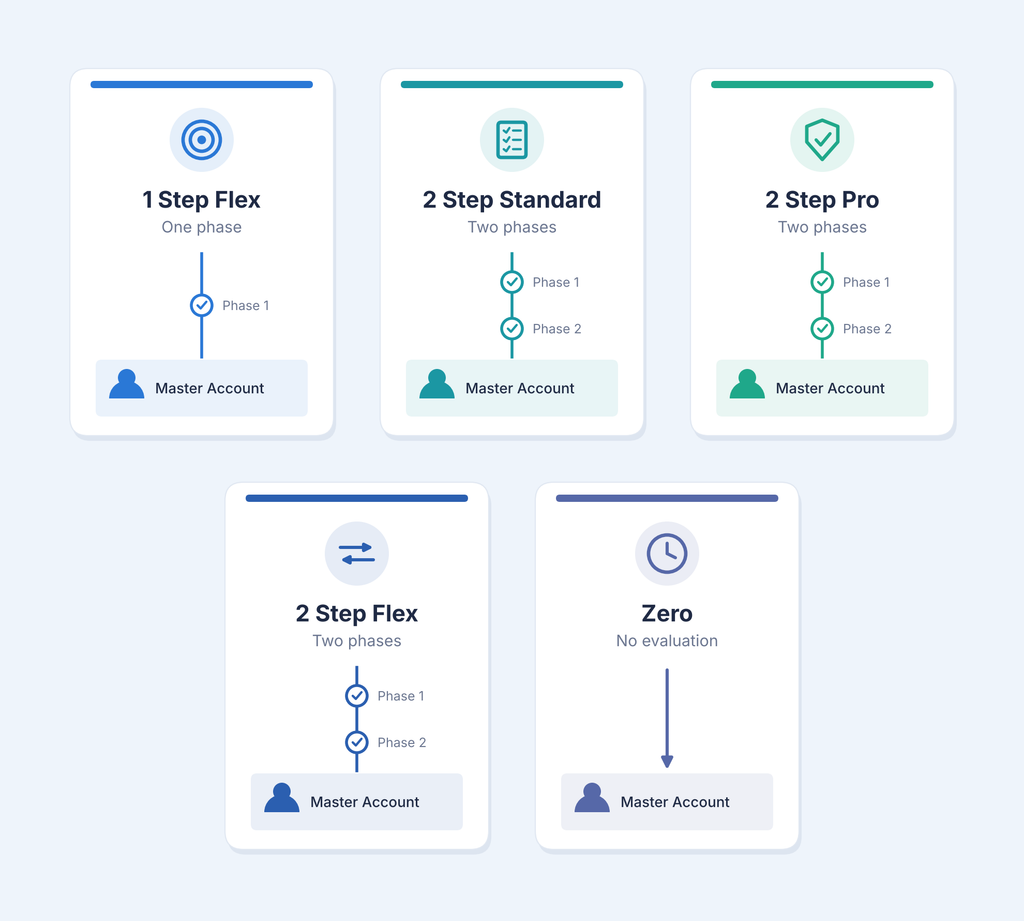
The appeal is variety. The current menu includes 1 Step Flex, 2 Step Standard, 2 Step Pro, 2 Step Flex and Zero, which skips the evaluation stage. Instead of forcing every trader into one standard challenge, the models vary their targets, loss limits, minimum trading days and rewards. That can make it easier to find a structure that resembles your trading style, but it also means the rules of one product should never be assumed to apply to another.
The central question is not whether FundingPips advertises large account sizes or high profit splits. It is whether a trader can meet the programme’s constraints repeatedly, withdraw under the chosen reward conditions, and still trade their own strategy without being pushed into inconsistent decisions.
Account Models at a Glance
FundingPips’ published comparison gives a useful overview. Exact terms can change, and add-ons or purchase-time choices may alter conditions, so confirm the specific checkout and account rules before buying.
| Model | Phases | Published profit target | Published max daily loss | Published max overall loss | General fit |
|---|---|---|---|---|---|
| 1 Step Flex | One phase | 12% | 2% or 3% | 12% static | Traders who want a single target phase and can tolerate a demanding objective |
| 2 Step Standard | Two phases | 8% / 5% | 3% or 5% | 10% static | Traders who prefer the classic two-stage route |
| 2 Step Pro | Two phases | 6% / 6% | 3% | 6% static | Traders who value smaller targets but can work within a tighter total loss cap |
| 2 Step Flex | Two phases | 10% / 8% | 4% | 12% static | Traders who want wider overall loss room and are comfortable with higher targets |
| Zero | No evaluation | No evaluation | 3% | 5% trailing | Experienced traders who prefer immediate access and can manage a trailing limit |
The table is a starting point, not a substitute for each model’s full terms. A 12% static overall limit may sound generous, but a 12% target on a one-phase evaluation is a different challenge from a two-step target. Zero removes the evaluation but not the risk controls: it has its own trailing maximum loss and reward eligibility requirements.
2 Step Standard
The Standard path is the familiar two-phase structure: an 8% target in Phase 1 and 5% in Phase 2, with a 10% static maximum overall loss. The published daily loss limit depends on the selected configuration, so verify whether the version you are buying carries a 3% or 5% limit. The three minimum trading days per phase also matter. A fast target hit may not be enough if the minimum-day requirement has not been met.
This is the most intuitive option for traders who want a conventional evaluation. Static overall drawdown is easier to reason about than a trailing limit, but the daily threshold still demands careful equity monitoring. “Static” does not mean risk-free or unaffected by floating losses.
2 Step Pro and 2 Step Flex
Pro uses 6% targets in both phases, a 6% static overall loss limit and a 3% daily limit. In the current comparison, it has no minimum trading days per phase. The smaller targets may seem attractive, but the tighter maximum loss leaves less room for a losing streak or oversized positions. It favours consistency and conservative exposure over recovery trading.
2 Step Flex raises the targets to 10% and 8%, with a 12% static overall loss limit and a 4% daily limit. The comparison lists a minimum of one trading day per phase. The extra loss room can suit traders with more variable day-to-day returns, though the bigger targets mean a higher performance hurdle.
1 Step Flex and Zero
1 Step Flex is a single-phase evaluation with a 12% target and a 12% static overall loss limit. Its daily limit is listed as 2% or 3%, depending on configuration. One phase means less administrative friction, not necessarily an easier pass: the target and the daily loss cap can make recovery from a poor start difficult.
Zero is the instant model. It starts at the Master Account stage with no evaluation. The published comparison lists a 5% trailing maximum loss, a 3% daily loss and a 1% maximum open-risk limit. Zero’s rules also specify 95% bi-weekly rewards, a 15% consistency ceiling, seven profitable days of at least 0.25% within the rolling 30-day period, and a 3% safety cushion before eligible reward requests. Zero is not simply “pay more, skip the test”. It replaces the evaluation hurdle with live account management and reward conditions.
Reward Cycles: Read the Fine Print
Payout choices are among FundingPips’ most marketable features, but they are not interchangeable. The current model comparison advertises different combinations, including weekly, bi-weekly and on-demand rewards, with splits varying by model. The firm’s help material does not line up perfectly across every page: one source lists a Standard weekly option at 60%, while the comparison table emphasises other combinations. Rely on the terms shown for the exact account you are activating, not a blog post, a promo graphic or a different model’s reward table.
For eligible cycles, an on-demand 100% reward split may be available, but “100%” is not the same as “unconditional.” The rules can require a consistency score of 35% or less, at least seven profitable days each earning 0.5% or more of the starting account size, and observance of the reward cycle and other requirements. The consistency calculation compares the largest winning day with total account profit. If one session accounts for too large a share, you may need additional profits on other days before requesting a reward.
That structure suits traders who earn steadily across many sessions. It can frustrate a trader whose edge comes from a few high-conviction trades or whose results are naturally lumpy. A lower split on a less restrictive cycle may be worth more in practice than a bigger advertised split your strategy rarely qualifies for.
Treat the payout cycle as a strategic decision. For some activations the choice is permanent, but the rule can depend on the model and current purchase terms. Before placing your first trade, confirm in writing whether the cycle can be changed and whether the selected split is locked. Do not plan on switching later unless the terms explicitly allow it.
Drawdown: Balance Is Not Enough
Daily loss rules are among the most important operational details. FundingPips describes daily limits using the opening balance or equity baseline at the platform-day reset. Equity includes floating profit or loss from open trades; balance does not. A position that is still open can therefore trigger a breach even if the closed-trade balance looks safe.
Equity vs balance reminder: Balance reflects closed trades. Equity reflects balance plus current floating gains or losses. Check the applicable daily floor and overall limit against equity in real time, including open positions, spread changes and rollover conditions.
A common mistake is to assume intraday profits permanently raise the day’s loss floor. The firm’s explanatory material illustrates that the daily threshold is set from the start-of-day baseline and does not simply reset upward because you booked a winner. Profits may give you more distance from that fixed floor, but the exact calculation depends on the model and current rules. Verify the dashboard’s threshold and the model’s help article rather than relying on a general explanation.
The overall loss limit also differs among products. Static drawdown is anchored to a defined starting account value, while Zero’s maximum loss is trailing. With a trailing threshold, gains can move the loss boundary according to the model’s rules, so you need to understand when and how it stops moving. A strategy that tolerates deep pullbacks after a strong run may be incompatible with a trailing limit even if it performs well on a static-drawdown account.
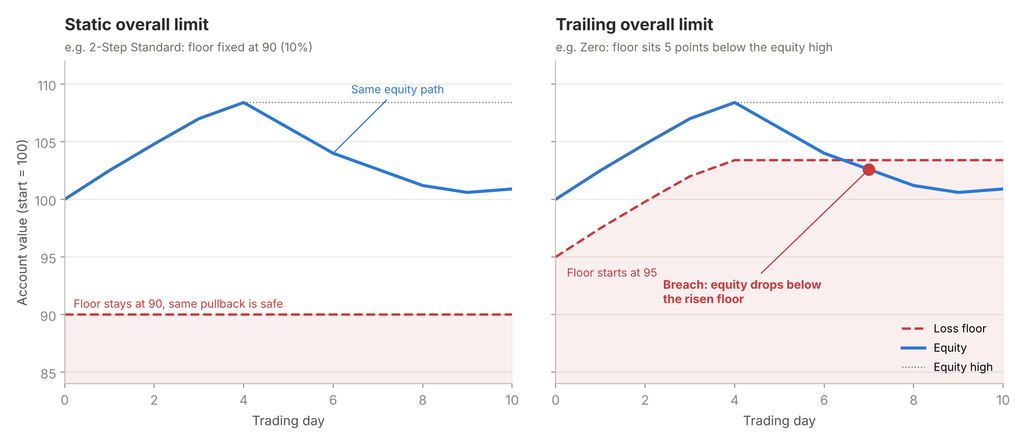
The same equity pullback is safe under a static limit but breaches a trailing one. Illustrative example only; check each model’s current loss rules on the FundingPips dashboard and help centre.
Risk Conduct, News and Holding Trades
FundingPips maintains trading-conduct rules in addition to numerical loss caps. The “Striking System” and related risk guidance deserve particular attention: published rule materials refer to warning triggers around trade-idea losses, and the threshold can vary by account or rule version. Do not reduce this to a universal “2%–3% per trade” guideline. Check the exact risk limit and how linked entries, partial closes or multiple positions are grouped into one idea. A trade can stay within the daily loss limit and still violate a separate conduct rule.
News restrictions are also model-specific. The firm’s policy distinguishes evaluation from Master Account behaviour, and its rules include restricted windows around certain high-impact releases and speeches. On Master Accounts for the 1 Step, 2 Step and Pro models, profits from trades opened or closed within five minutes either side of such an event are not counted, unless the trade was opened at least five hours before it. Deliberately trading the news is prohibited and can lead to termination. Zero has stricter restrictions: holding or opening a position inside its ten-minute windows is a breach. Always consult the FundingPips dashboard calendar, which the firm identifies as the official news source, and use the exact account policy.
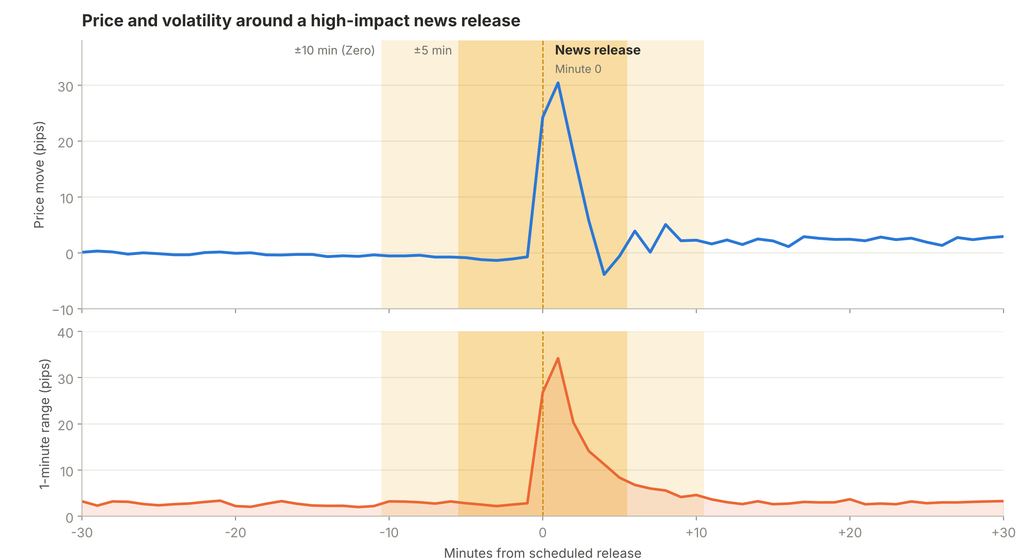
Illustrative price and volatility around a high-impact release. Shaded bands show the ±5 minute window and the stricter ±10 minute Zero window.
Confirm current windows for your account type on the FundingPips help centre.
Do not assume the holding rules are the same across models. FundingPips’ help article says that on 1 Step, 2 Step and Pro accounts you can hold trades over the weekend, both during the evaluation and on the Master Account, while Zero prohibits weekend holds and treats a violation as an account breach. Holding rules have changed over time, though, and some third-party reports describe a temporary weekend restriction on Master Accounts. Before you buy, check the current rule for your exact model on the dashboard or with support, and keep a copy of the answer.
Platforms and execution conditions can also vary. FundingPips’ materials mention platforms such as MT5, cTrader and Match-Trader, but availability can differ by programme and current setup. Confirm the exact platform at checkout. Pay attention to spreads, commissions, swap charges and rollover slippage: a nominal loss limit does not protect you from a gap or an execution event that pushes equity past the threshold.
Price, Refunds and Accessibility
What it costs
FundingPips charges a one-time fee for each account. The fee depends on the model and the account size. The table shows the entry price for each model, which is the cheapest size at $5,000. These are the prices we checked on 9 November 2026.
| Model | Fee from (at $5K) |
| 2 Step Pro | $29 |
| 2 Step Flex | $35 |
| 2 Step Standard | $39 |
| Zero | $60 |
| 1 Step Flex | $74 |
Larger accounts cost more, and the price rises with size. Prices changed in 2026, so older reviews may show different numbers. Promotions and add-ons can also alter the total, and accounts bought before 28 September 2026 keep the terms they were bought under. Always confirm the final price for your chosen model and size at checkout.
Refunds
Treat the fee as money you may not get back.
- FundingPips’ terms say fees are non-refundable once paid, except where the law requires otherwise.
- If you fail an evaluation, the account ends and the fee is not returned.
- The main exception is the 2 Step Standard model. Its original fee is refunded when you reach your fourth reward on the Master Account.
- According to FundingPips’ help centre, this refund does not apply to 1 Step Flex, 2 Step Pro, 2 Step Flex or Zero.
- Some older blog posts say passing a challenge earns a refund. The current terms are more specific, so rely on those.
Refund rules have been revised more than once. Ask support to confirm the terms for your model in writing before you pay.
Extra costs
- Swing add-on. Holding positions overnight or over the weekend may require the optional Swing add-on. At checkout it was priced at 10% of the account fee on the 2 Step Flex $100K account (+$55.50 on $555). Check the price for your model and size.
- cTrader. Choosing cTrader instead of MetaTrader 5 added $20 at checkout on the account we checked.
- Zero resets. Zero has no evaluation fee, only a one-time registration fee. If a Zero account is breached, FundingPips offers a reset at a discount, but you need to restart within seven calendar days.
- Payment and withdrawal fees. Check these separately, as they depend on your method.
Accessibility
- Entry cost. Entry-level accounts start under $40 on some models, so the barrier to trying a challenge is low. The cheapest model is not always the easiest to pass.
- Instant access. Zero skips the evaluation and starts at the Master Account stage, but it comes with a trailing loss limit and reward conditions.
- Platforms. Checkout offers MetaTrader 5, MatchTrader and cTrader, though availability and extra charges can differ by programme, so confirm your platform at checkout.
- Regional availability. Check that your country is supported before paying.
How it compares
A useful comparison is not “Which firm has the highest percentage?” but “Which rule set fits the way I trade?” Against a two-phase competitor such as FundedNext or FTMO, compare daily loss baselines, whether overall drawdown is static or trailing, evaluation targets, news restrictions and payout timing at equivalent account sizes. A headline comparison can mislead when one firm measures loss using equity and another describes the threshold differently.
| Comparison point | ||
| Account choice | ||
| Drawdown | Static limits on several evaluations; trailing limit on Zero | Whether the daily baseline is balance, equity or a defined reset value |
| Rewards | Cycle and split differ by model; conditions may include consistency | First eligible request date, minimum payout, required trading days and deductions |
| Trading restrictions | News, weekend and conduct rules vary by account | Restricted windows, add-ons, and what counts as a breach |
| Costs | One-time fee by model and size; refund only on 2 Step Standard after the 4th reward; optional Swing add-on | Total checkout cost, refund conditions, add-ons, and fees for payment or withdrawal |
FundingPips’ distinctive strength is the range of account structures and reward-cycle choices, not a guarantee that every trader will find the rules easy. FTMO and other established competitors may offer clearer or different structures for some trading styles, but the fairest comparison requires checking their current official rules side by side. Avoid categorical claims that one firm is safer or more reliable based on marketing copy alone.
Pros and Cons
Pros
- Several account formats, including one-step, two-step and instant-access Zero
- Different loss limits and profit targets let traders compare a range of approaches
- Static overall drawdown on multiple evaluation models is straightforward to plan around
- Reward structures offer different trade-offs between timing, eligibility and profit split
- The official help centre includes model comparisons and detailed explanations of equity, execution and news rules
Cons
- The number of models makes it easy to confuse one account’s rules with another’s
- A high advertised split can come with consistency, profitable-day or safety-cushion requirements
- Equity-based loss monitoring can surprise traders who track balance alone
- News, weekend and risk-conduct restrictions may affect strategy choice and reward eligibility
- Prices, platforms and terms can change, and third-party summaries can be stale or inconsistent
How to Choose and Trade Carefully
Start with your own trade log, not the account menu. Measure your average daily return, worst drawdown, winning-day concentration, holding time and how often you trade near high-impact news. Then match those numbers to a model’s targets and limits. A trader with a few large winning days may be a poor fit for a strict consistency condition, and a trader who holds positions through weekends may need a different model or provider.
Before buying, make a one-page rule sheet for the account: daily loss baseline, overall loss limit, minimum trading days, reward cycle, consistency condition, news windows, weekend rule and any risk-per-idea restriction. Use the firm’s own current account page and save a copy of the terms shown at purchase. If an important point is unclear, especially whether a payout cycle is locked, ask support and keep the response.
During trading, size positions from the loss limit rather than the profit target. Monitor equity, keep a buffer from the daily and overall thresholds, and account for spreads and rollover. Do not try to “make back” losses by increasing size, which is especially dangerous when hard limits are enforced automatically. Before a reward request, check that the account meets every cycle-specific condition, not just the minimum profit amount.

Related reviews: FTMO review · The5ers review · FundedNext review
FundingPips Review: Final Verdict
FundingPips can be worth considering for traders who want multiple challenge formats and are willing to manage a detailed rule set. The 2 Step Standard is recognisable, Pro offers smaller targets with a tighter loss cap, the Flex variants shift the balance between targets and drawdown, and Zero removes the evaluation while imposing its own trailing loss and reward hurdles. Those differences make the line-up useful, but not automatically simple.
The most important caveat is that payout flexibility is conditional. A 100% split headline does not mean a guaranteed or immediate withdrawal, and a model that looks affordable can become a poor fit if its consistency or holding restrictions conflict with your strategy. Nor should “funded” be read as a promise of a live brokerage account: FundingPips describes its programmes as simulated trading with cash rewards under its terms.
We rate FundingPips 3.9/5: above average for model variety and configurable rewards, but marked down for rule complexity and for how much you need to confirm across account-specific pages. The right choice is the model whose drawdown and payout requirements you can follow during ordinary trading, not the one with the most compelling headline percentage.
Before paying, review the current official terms, check regional availability, and only risk an evaluation fee you can afford to lose. Promotional codes and prices should be verified at checkout, and no discount changes the underlying risk rules.
Trading carries a high risk of loss. Simulated and evaluation accounts do not guarantee live-market performance or payouts. Nothing on this page is financial advice.