Introduction
One of the first things every new trader must understand is the concept of currency pairs. These pairs form the foundation of every forex trade, and knowing how they behave is essential for building a profitable strategy. In this guide, you’ll get the top currency pairs in forex trading explained in a clear, beginner‑friendly way. We’ll break down the different categories of pairs, what drives their movements, and why some are more popular than others.
Whether you’re just starting out or refining your knowledge, this article will help you understand how the world’s most traded currencies shape the forex market.

What Are Currency Pairs?
In forex, currencies are always traded in pairs. This is because you are simultaneously buying one currency and selling another. A currency pair is written in the format:
BASE / QUOTE
For example:
- EUR/USD
- GBP/USD
- USD/JPY
The base currency is the first currency in the pair, and the quote currency is the second. If EUR/USD is trading at 1.0800, it means: 1 Euro = 1.08 US Dollars
When the price rises, the euro is strengthening. When it falls, the euro is weakening.
Understanding this structure is essential before diving into the different types of pairs.
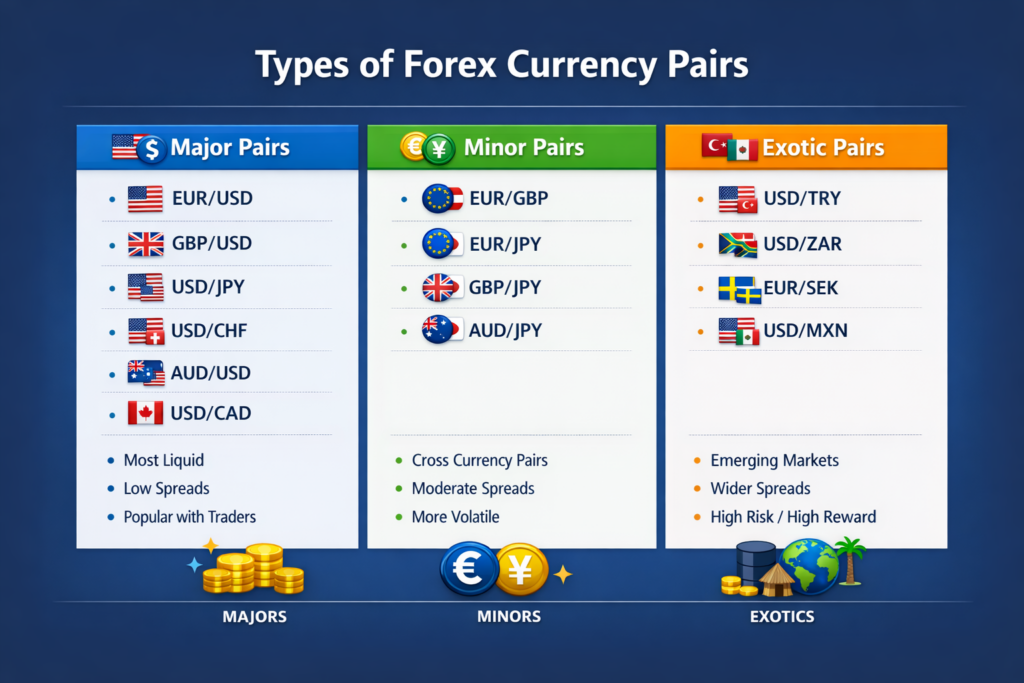
The Three Types of Currency Pairs
Forex pairs are grouped into three categories:
- Major pairs
- Minor pairs
- Exotic pairs
Each behaves differently and suits different trading styles.
1. Major Currency Pairs
The major pairs are the most traded and most liquid in the world. They all include the US Dollar (USD), which is the world’s primary reserve currency.
The major pairs are:
- EUR/USD – Euro vs US Dollar
- GBP/USD – British Pound vs US Dollar
- USD/JPY – US Dollar vs Japanese Yen
- USD/CHF – US Dollar vs Swiss Franc
- AUD/USD – Australian Dollar vs US Dollar
- NZD/USD – New Zealand Dollar vs US Dollar
- USD/CAD – US Dollar vs Canadian Dollar
Why Major Pairs Are Popular
- High liquidity
- Tight spreads
- Predictable behaviour
- Abundant economic data
- Ideal for beginners
If you’re new to trading, major pairs are the safest place to start.
2. Minor Currency Pairs
Minor pairs (also called cross pairs) do not include the US Dollar. Examples include:
- EUR/GBP
- EUR/JPY
- GBP/JPY
- AUD/JPY
Characteristics of Minor Pairs
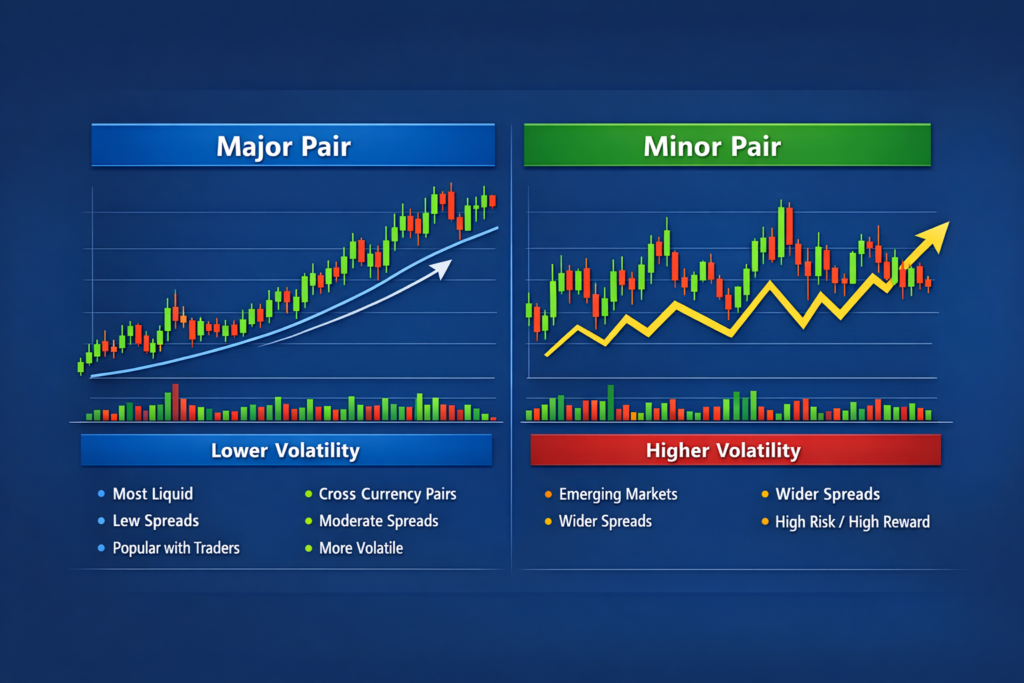
- Slightly wider spreads than majors
- More volatile
- Influenced by regional economic events
- Popular among intermediate traders
Pairs like GBP/JPY are known for fast, explosive moves — great for experienced traders, but risky for beginners.
3. Exotic Currency Pairs
Exotic pairs include one major currency and one currency from a developing or emerging economy.
Examples:
- USD/TRY – US Dollar vs Turkish Lira
- USD/ZAR – US Dollar vs South African Rand
- EUR/SEK – Euro vs Swedish Krona
- USD/MXN – US Dollar vs Mexican Peso
Characteristics of Exotic Pairs
- High volatility
- Wider spreads
- Lower liquidity
- Strongly affected by political and economic instabilit
Exotics can offer big moves, but they require caution and experience.
What Influences Currency Pair Movements?
Understanding what moves currency pairs helps traders make informed decisions. The top currency pairs in forex trading explained guide gives you a good footing to gain insight in the forex trading.
1. Economic Indicators
GDP, inflation, employment data, and manufacturing reports can all move markets.
2. Interest Rates
Central banks like the Federal Reserve or Bank of England influence currency strength through rate decisions. You can track global interest rate decisions directly from the Bank for International Settlements: https://www.bis.org/statistics/
3. Political Stability
Elections, policy changes, and geopolitical tensions can cause sharp movements.
4. Market Sentiment
Sometimes traders move markets based on expectations rather than facts.
5. Commodity Prices
Some currencies are tied to commodities:
- AUD → gold
- CAD → oil
- NZD → agriculture
When commodities rise or fall, these currencies often follow. Traders often monitor upcoming economic releases using the Forex Factory economic calendar: https://www.forexfactory.com/calendar
How to Choose Which Currency Pairs to Trade
Choosing the right pair depends on your trading style, risk tolerance, and experience level. The top currency pairs in forex trading explained guide would help you with the right trading style and risk tolerance awareness.
For Beginners
Stick to major pairs like:
- EUR/USD
- GBP/USD
- USD/JPY
They’re stable, predictable, and cost‑efficient.
For Intermediate Traders
Minor pairs offer more movement:
- EUR/JPY
- GBP/JPY
- AUD/JPY
For Advanced Traders
Exotics provide volatility and opportunity — but also risk. For deeper insights into chart patterns and indicators, visit our Technical Analysis section.
Tips for Trading Currency Pairs Successfully
1. Understand the Pair’s Personality
Learn how top currency pairs in forex trading explained guide would help you to trade successfully.
Each pair has its own rhythm.
EUR/USD is smooth.
GBP/JPY is wild.
USD/JPY is sensitive to interest rates.
2. Follow Economic Calendars
News events can cause major spikes.
Always check the calendar before entering a trade.
3. Use Risk Management
Set stop‑losses, avoid over‑leveraging, and never risk more than you can afford.
4. Backtest Your Strategy
Test your approach on historical data before trading live.
5. Start Simple
Master one or two pairs before expanding.
Managing emotions is essential for consistent results. Our Psychology section covers this in detail.
Conclusion
Understanding the major, minor, and exotic currency pairs is a crucial step in becoming a confident forex trader. With the top currency pairs in forex trading explained clearly, you now have the foundation to choose the right pairs for your strategy and skill level.
In the next article, we’ll explore how to read forex charts, giving you the tools to analyse price movements like a professional.