Introduction
If you want to trade forex successfully, you must understand how to read charts. Charts show you how price moves, where trends form, and where opportunities appear. In this guide, you’ll get how to read forex charts for beginners explained in a simple, practical way. We’ll break down chart types, candlesticks, timeframes, indicators, and patterns so you can analyse the market with confidence.
What Is a Forex Chart?
A forex chart is a visual representation of how a currency pair’s price changes over time. Traders use charts to:
- Identify trends
- Spot reversals
- Time entries and exits
- Analyse market behaviour
Charts are the foundation of technical analysis, which you can explore further in our Technical Analysis section.
Types of Forex Charts
Learning how to read forex charts for beginners starts with understanding the basic structure of price movement and how different chart types display market behaviour. There are three main chart types used by traders:
1. Line Chart
A line chart connects closing prices over a selected timeframe. It’s simple and ideal for beginners.
Pros
- Easy to read
- Great for identifying overall trends
Cons
- Lacks detail
- Doesn’t show highs, lows, or volatility
2. Bar Chart
A bar chart shows the open, high, low, and close (OHLC) for each period.
Pros
- More detail than line charts
- Shows volatility
Cons
- Harder for beginners to interpret
3. Candlestick Chart
Candlestick patterns are one of the most important parts of how to read forex charts for beginners, because they reveal market sentiment at a glance. Candlestick charts are the most popular because they show:
- Open
- High
- Low
- Close
- Market sentiment
Candlesticks form patterns that help traders predict future movements.
Understanding Candlesticks
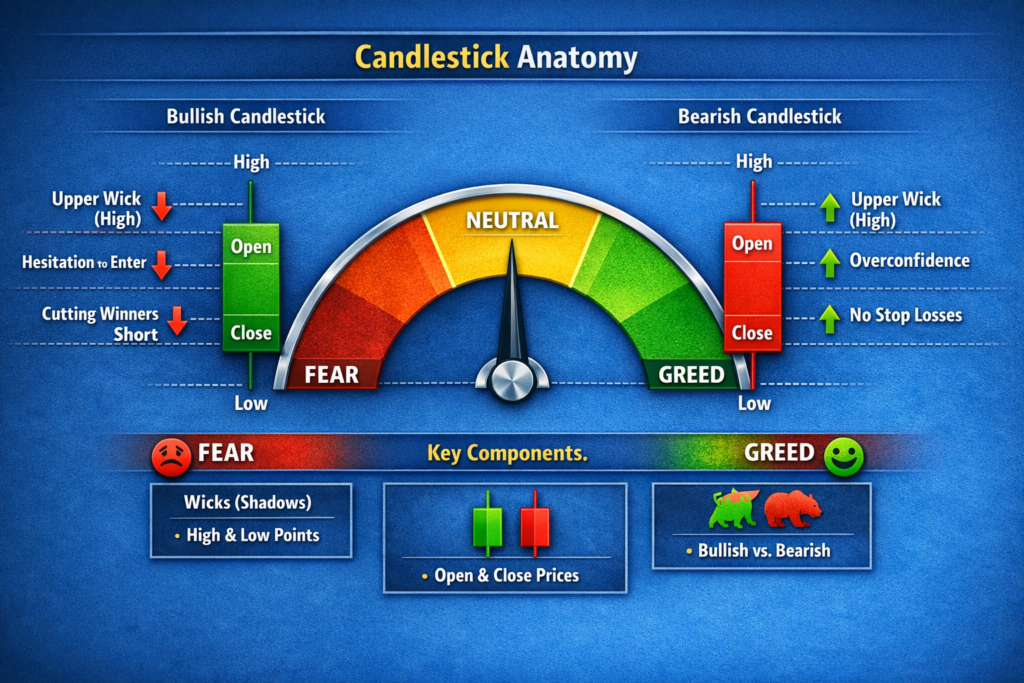
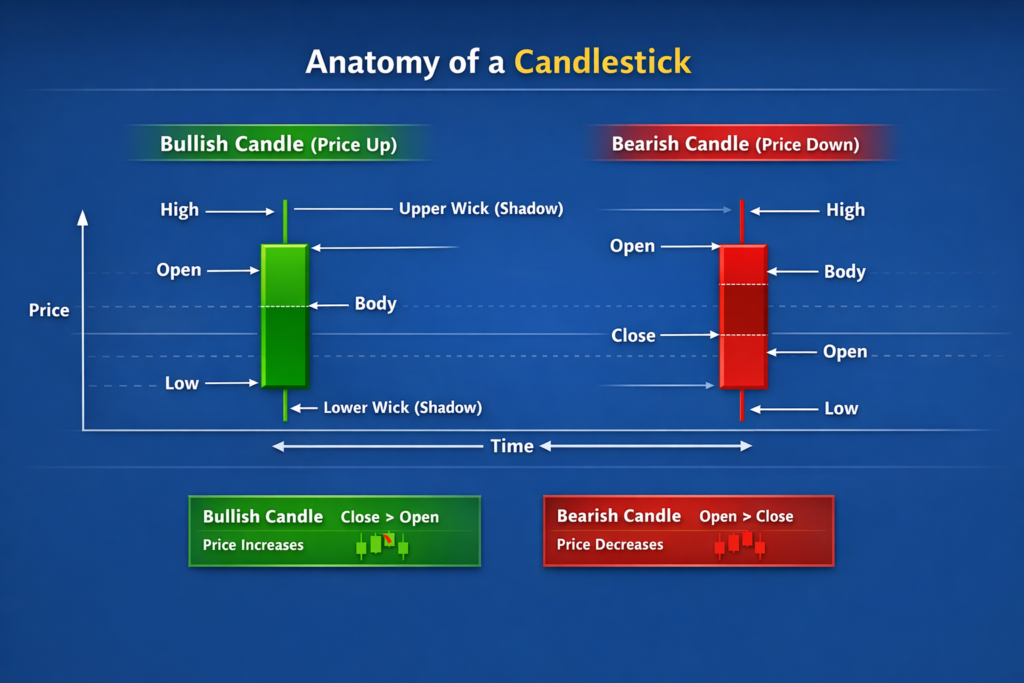
Each candlestick represents a specific timeframe (1 minute, 1 hour, 1 day, etc.).
Bullish Candle (Price Up)
- Body is usually green or white
- Close is above the open
Bearish Candle (Price Down)
- Body is usually red or black
- Close is below the open
Wicks (Shadows)
- Show the highest and lowest prices reached
Candlesticks reveal market psychology — fear, greed, indecision, and momentum.
Timeframes Explained
When mastering how to read forex charts for beginners, choosing the right timeframe is essential, as it determines how much noise or clarity you see in the market. Forex charts can be viewed in multiple timeframes:
- M1, M5, M15 → Scalping
- H1, H4 → Day trading
- D1, W1 → Swing and position trading
Beginners should start with H1 or H4, as they offer clearer trends and less noise.
For deeper market context, visit our Fundamental Analysis category.
Identifying Trends
A trend is the general direction of price movement.
Uptrend
- Higher highs
- Higher lows
Downtrend
- Lower highs
- Lower lows
Sideways Trend
- Price moves within a range
Trends are easier to spot using tools like moving averages.
Using Indicators on Forex Charts
Indicators like RSI and moving averages play a major role in how to read forex charts for beginners, helping traders confirm trends and spot reversals.
Indicators help traders analyse price behaviour. Here are the most common ones:
1. Moving Averages (MA)
Smooth out price data to show trend direction.
- 50 MA → Medium-term trend
- 200 MA → Long-term trend
2. Relative Strength Index (RSI)
Measures momentum.
- Above 70 → Overbought
- Below 30 → Oversold
3. MACD
Shows trend strength and momentum shifts.
4. Support and Resistance Levels
These are price zones where the market tends to react.
- Support → Price bounces upward
- Resistance → Price reverses downward
You can learn more about chart patterns and indicators in our Technical Analysis section.
Common Chart Patterns
Patterns help traders anticipate future movements.
1. Double Top / Double Bottom
Signals trend reversals.
2. Head and Shoulders
Indicates a major reversal.
3. Triangles
Show consolidation before a breakout.
4. Flags and Pennants
Continuation patterns during strong trends.
Using Economic Data With Charts
Charts show price action, but economic events drive it.
Use the Forex Factory economic calendar to track news:
https://www.forexfactory.com/calendar
For interest rate decisions, check the Bank for International Settlements:
https://www.bis.org/statistics/
For market hours and volatility patterns, see:https://www.investopedia.com/forex-market-hours-4684027 (investopedia.com in Bing)
Conclusion
With how to read forex charts for beginners explained clearly, you now understand the basics of chart types, candlesticks, timeframes, indicators, and patterns. In the next article, we’ll explore technical indicators in depth, helping you build a stronger trading strategy.