Understanding GDP growth helps traders see what drives an economy — and how those forces influence currency strength. By breaking GDP into its four components, you get a clearer picture of what’s pushing growth up or down, and how markets might react. This GDP growth overview helps traders understand how each component influences currency strength.
What Are the Components of GDP?
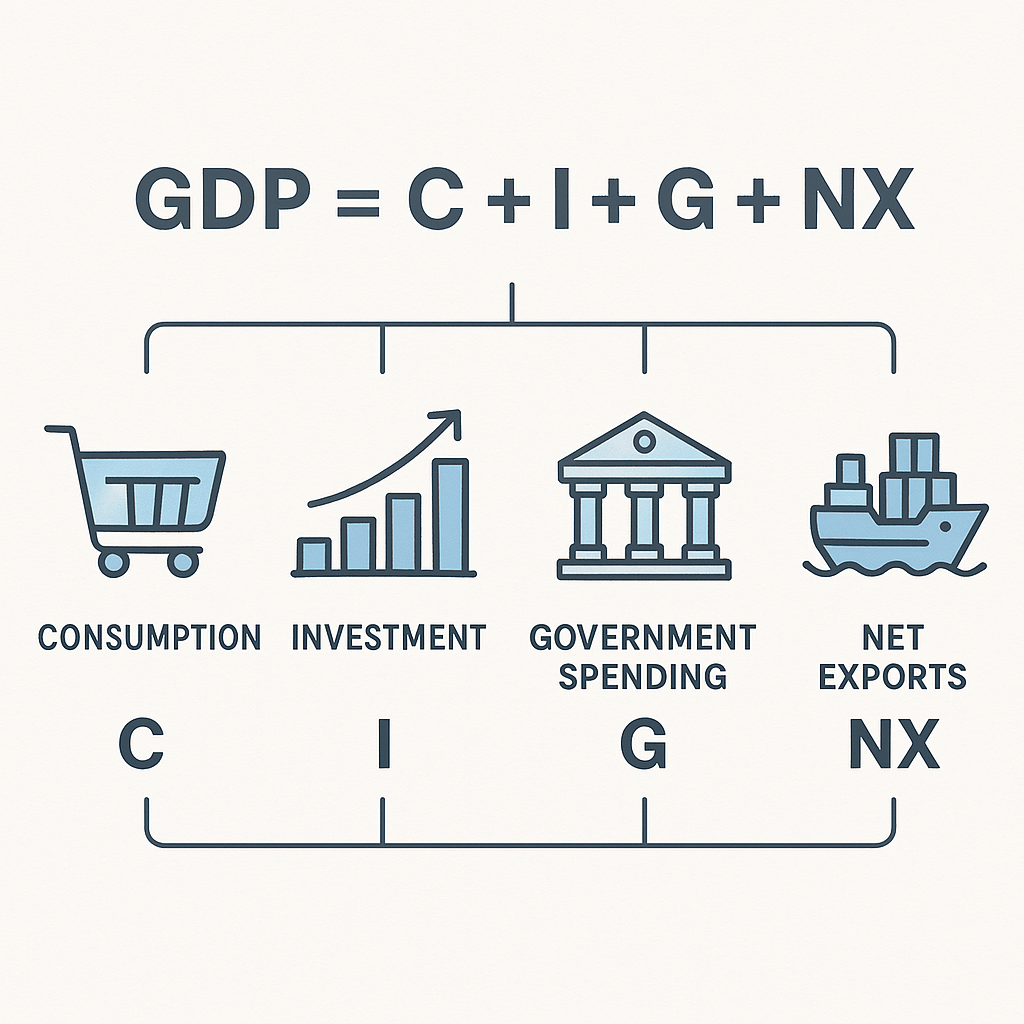
Economists calculate GDP using the formula:
GDP=C+I+G+NX
Where:
- C = Consumption
- I = Investment
- G = Government Spending
- NX = Net Exports
Each component affects the economy differently — and each one influences Forex markets in its own way.
Consumption (C)
Consumption is the largest part of GDP in most developed economies. It includes:
- household spending
- services
- retail purchases
- durable goods (cars, appliances)
- non‑durable goods (food, clothing)
When consumers spend more, businesses grow, employment rises, and GDP increases.
Why Consumption Matters in Forex
Strong consumption usually supports a stronger currency because it signals: - economic confidence
- stable income
- strong job market
Weak consumption often signals economic slowdown ahead.
Investment (I)
Investment includes:
- business spending
- equipment purchases
- construction
- inventory changes
- housing investment
Investment is more volatile than consumption because businesses adjust spending quickly when conditions change.
Why Investment Matters in Forex
Rising investment shows: - business confidence
- future economic expansion
- strong credit conditions
Falling investment can signal recession risk, which may weaken a currency.
Government Spending (G)
Government spending includes:
- infrastructure
- public services
- defense
- education
- healthcare
This component is usually stable because governments plan budgets in advance.
Why Government Spending Matters in Forex
Higher government spending can boost GDP in the short term, but long‑term effects depend on:
Net ExporNet exports measure the difference between:ts (NX)
- debt levels
- taxation
- economic efficiency
If spending increases growth without excessive debt, it can support currency strength.
Net Exports (NX)
Net exports measure the difference between:
- Exports (goods sold abroad)
- Imports (goods bought from abroad)
A positive NX (trade surplus) strengthens a currency because foreign buyers must purchase the local currency to pay for exports.
A negative NX (trade deficit) can weaken a currency because the country spends more on imports than it earns from exports.
Export‑driven economies like Japan, China, and Germany are especially sensitive to this component.
Which Components Move Currencies the Most?
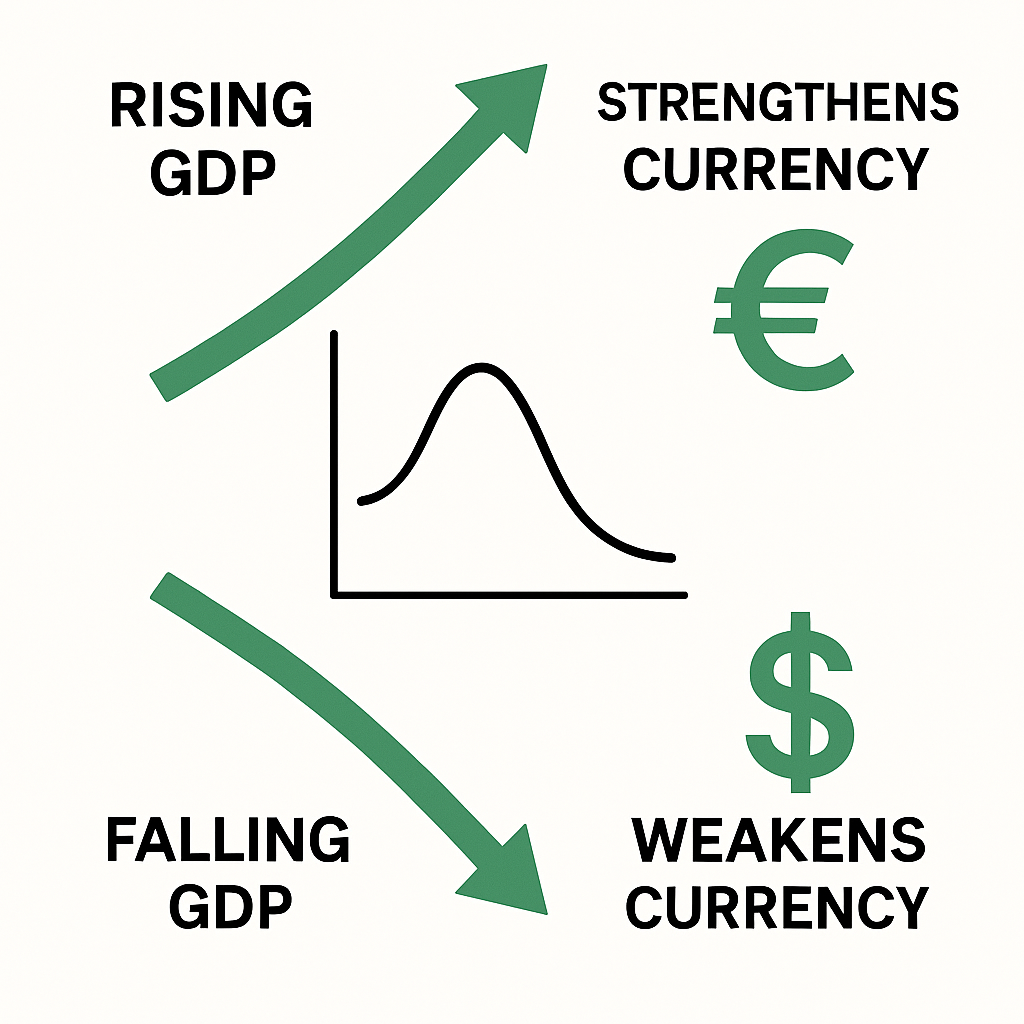
Not all components influence Forex markets equally.
- Consumption (C)
The biggest driver in most economies.
Strong consumption = strong currency outlook. - Investment (I)
Highly sensitive to interest rates and business confidence.
A sharp drop often signals recession. - Net Exports (NX)
Critical for export‑driven economies. - Government Spending (G)
Important, but less reactive in the short term.
For deeper context, see your pillar article: What Is GDP?
How Traders Use GDP Components
Forex traders study GDP components to understand:
- what’s driving growth
- whether growth is sustainable
- how central banks might react
- which currencies may strengthen or weaken
Examples: - If consumption is strong but investment is falling, growth may not last.
- If exports are rising, the currency may strengthen due to foreign demand.
- If government spending is the only thing holding GDP up, markets may worry about debt.
GDP components help traders see the quality of economic growth — not just the headline number.
Read more about this here: What Is GDP?
GDP Growth Overview: Key Takeaways for Traders
Breaking GDP into its components gives traders a deeper understanding of economic strength. By studying a GDP growth overview, traders can better anticipate how central banks may react to economic trends
Each part — consumption, investment, government spending, and net exports — tells a different story about how the economy is performing and where it may be heading.
For Forex traders, this breakdown helps you:
Understanding how each component contributes to GDP gives traders a clearer sense of economic momentum. When combined with other indicators like inflation and employment, a GDP growth overview becomes a powerful tool for evaluating currency strength
compare countries more accurately
For more depth, see: GDP and Economic Growth in Forex
And for broader context: Economic Cycles & Currency Strength (future article)
interpret GDP releases
understand currency movements
anticipate central bank decisions