Introduction
Forex trading explained—foreign exchange trading is the global marketplace where currencies are bought and sold. It is the largest and most liquid financial market in the world, with more than $6 trillion traded every single day. Unlike the stock market, the forex market operates 24 hours a day, five days a week, and is accessible to traders of all experience levels.
Whether you’re completely new to forex or looking to refine your understanding, this article breaks down how the market works, why it exists, and what traders need to know before getting started. This guide gives forex trading explained for beginners in a clear, practical way so new traders can understand how the market works.
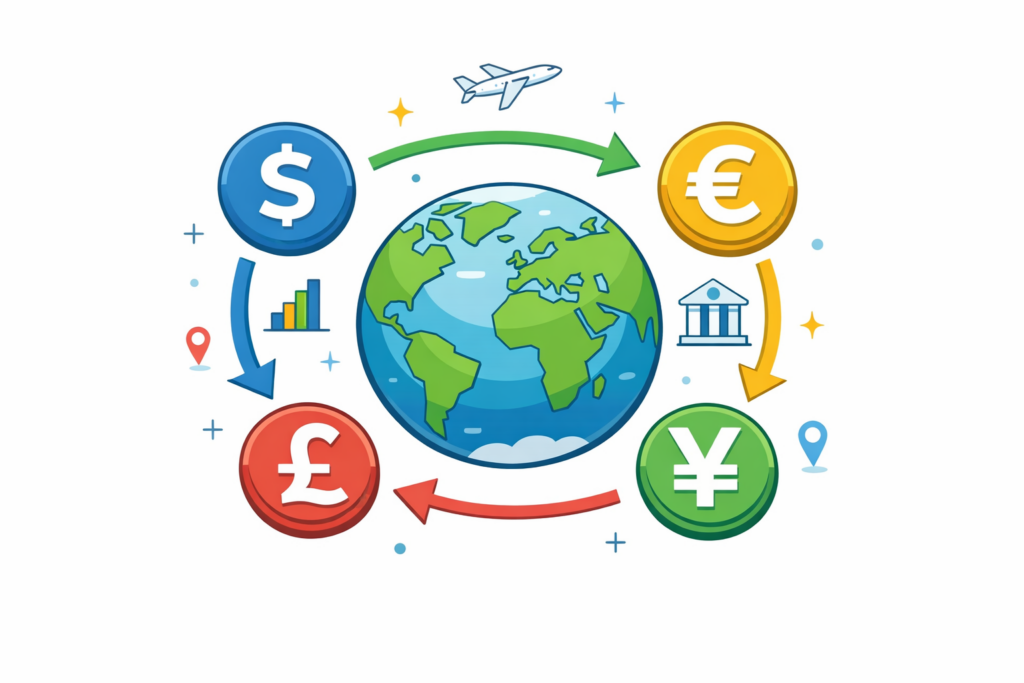
This guide is designed to give you forex trading explained in simple, practical terms so beginners can understand how the market really works.
What Is Forex Trading? (Forex Trading Explained for Beginners)
Forex trading involves exchanging one currency for another with the goal of making a profit. Every forex trade involves a currency pair, such as:
- EUR/USD (Euro vs US Dollar)
- GBP/JPY (British Pound vs Japanese Yen)
- USD/CHF (US Dollar vs Swiss Franc)
When you trade forex, you are speculating on whether one currency will strengthen or weaken relative to another.
For example:
If you believe the euro will rise against the US dollar, you would buy EUR/USD.
If you believe the euro will fall, you would sell EUR/USD.
This simple structure is what makes forex accessible even to beginners.
How the Forex Market Works
Unlike stock markets, forex does not have a central exchange. Instead, it operates through a global network of banks, brokers, and financial institutions. This is known as an over‑the‑counter (OTC) market.
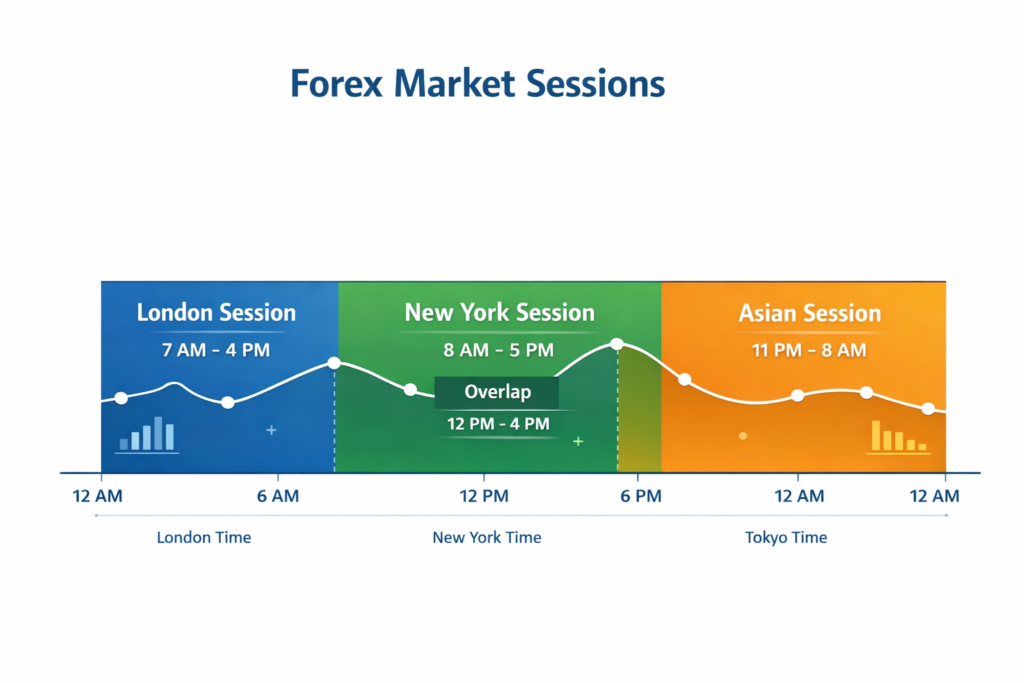
The forex market is divided into three main sessions:
- London Session
- New York Session
- Asian Session
These sessions overlap, which is why the market is open 24 hours a day from Monday to Friday.
Why Forex Is So Liquid
Forex is the most liquid market in the world because:
- Governments and central banks trade currencies
- Large corporations exchange money for international business
- Banks hedge currency exposure
- Retail traders speculate on price movements
This constant flow of money creates opportunities for traders at all times of the day.
Understanding Currency Pairs
Every forex pair has two parts:
- Base currency (the first currency)
- Quote currency (the second currency)
Example:
In GBP/USD, the British Pound is the base currency and the US Dollar is the quote currency.
If GBP/USD is trading at 1.2500, it means:
1 British Pound = 1.25 US Dollars
When the price moves from 1.2500 to 1.2600, the pound has strengthened.
When it moves from 1.2500 to 1.2400, the pound has weakened.
What Moves the Forex Market?
Currency prices change based on supply and demand, but several key factors influence this:
1. Economic Data
Reports such as GDP, inflation, and employment numbers can cause major price movements.
2. Interest Rates
Central banks (like the Bank of England or Federal Reserve) adjust interest rates to control inflation. Higher interest rates usually strengthen a currency. You can view global interest rate decisions directly from the Bank for International Settlements: https://www.bis.org/statistics/
3. Political Events
Elections, policy changes, and geopolitical tensions can create volatility.
4. Market Sentiment
Sometimes traders move markets simply based on expectations or fear — even before real data is released.
How Traders Make Money in Forex
Forex traders aim to profit from price movements. There are three main trading styles:
1. Day Trading
Short‑term trades that open and close within the same day.
2. Swing Trading
Trades held for several days or weeks, based on medium‑term trends.
3. Position Trading
Long‑term trades based on economic fundamentals.
Traders use tools like:
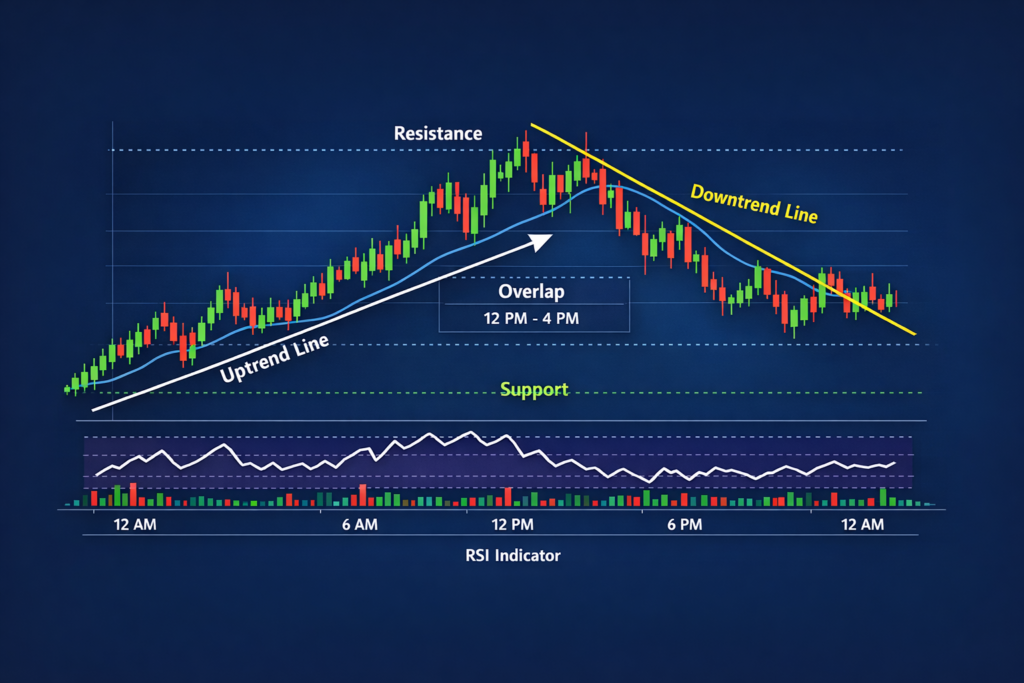
- Technical analysis
- Chart patterns
- Indicators (RSI, MACD, moving averages)
- Fundamental analysis
The goal is to identify high‑probability opportunities while managing risk. To benefit more from this forex trading explained guide, learn more about chart patterns and indicators by visiting our Technical Analysis section.
The Role of Leverage in Forex
Leverage allows traders to control larger positions with a smaller amount of capital. For example, with 1:30 leverage, a £100 deposit can control a £3,000 position.
While leverage increases potential profits, it also increases potential losses. This is why risk management is essential.
Risks of Forex Trading
In this forex trading explained guide, you should learn the opportunities trading offers, and the risks it carries.
- High volatility
- Leverage amplifying losses
- Emotional decision‑making
- Overtrading
- Lack of a clear strategy
Successful traders focus on discipline, risk control, and continuous learning.
Conclusion
Forex trading is a dynamic and accessible market that offers opportunities for traders around the world. Understanding how currency pairs work, what moves the market, and how to manage risk is essential before placing your first trade.
With forex trading explained step‑by‑step, you now have the foundation needed to explore strategies, tools, and deeper market concepts. For official economic releases, traders often monitor the economic calendar provided by Forex Factory: https://www.forexfactory.com/calendar
This article gives you a strong foundation — and in the next articles, we’ll go deeper into strategies, tools, and practical techniques you can use to trade more effectively.