Introduction
Technical indicators are essential tools for forex traders. They help you analyse price movements, confirm trends, and make smarter decisions. In this guide, we’ll explore the best technical indicators for forex trading, explain how they work, and show you how to use them effectively.
Whether you’re a beginner or refining your strategy, these indicators will help you trade with more confidence and precision.
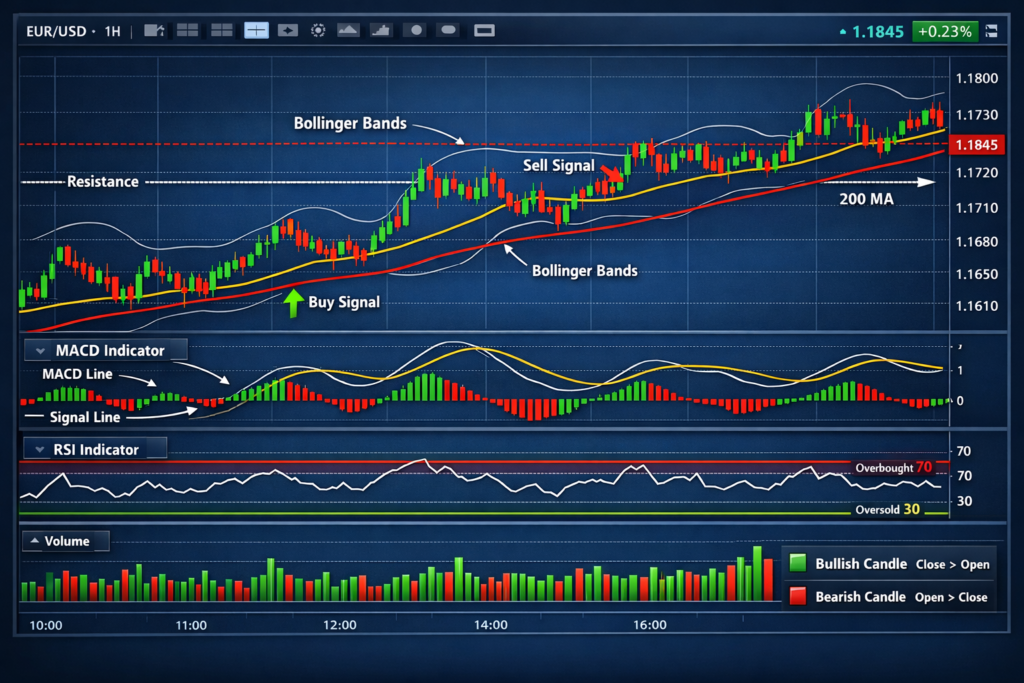
What Are Technical Indicators?
Technical indicators are mathematical calculations based on price, volume, or volatility. They help traders:
- Identify trends
- Spot reversals
- Confirm entry and exit points
- Measure momentum and strength
Indicators are part of technical analysis, which you can explore further in our Technical Analysis section.
Top Technical Indicators for Forex Trading
Best Technical Indicators for Forex Trading: Let’s break down the most popular and effective indicators used by forex traders.
Moving Averages (MA)
Moving averages smooth out price data to show the direction of the trend.
Types
- Simple Moving Average (SMA)
- Exponential Moving Average (EMA)
Common Settings - 50-period → medium-term
- 200-period → long-term
Use Case - Identify trend direction
- Spot dynamic support/resistance
Relative Strength Index (RSI)
RSI measures momentum and identifies overbought or oversold conditions.
- Above 70 → Overbought
- Below 30 → Oversold
Use Case - Spot potential reversals
- Confirm trend strength
3. MACD (Moving Average Convergence Divergence)
MACD shows the relationship between two moving averages. MACD is one of the best technical indicators for forex trading because it helps traders confirm trend direction and momentum shifts with precision.
Components
- MACD line
- Signal line
- Histogram
Use Case - Identify trend changes
- Spot bullish/bearish crossovers
[Image Placeholder 4‑2: MACD and RSI comparison chart]
4. Bollinger Bands
Bollinger Bands measure volatility and show price extremes. Bollinger Bands are widely considered among the best technical indicators for forex trading, especially for identifying volatility and breakout zones.
Structure
- Middle band (SMA)
- Upper and lower bands (standard deviations)
Use Case - Spot breakouts
- Identify overbought/oversold zones
5. Stochastic Oscillator
Compares closing price to its range over a set period.
- Above 80 → Overbought
- Below 20 → Oversold
Use Case - Spot reversals
- Confirm momentum
6. ATR (Average True Range)
Measures market volatility.
Use Case
- Set stop-loss levels
- Gauge risk and position sizing
7. Fibonacci Retracement
Uses key ratios (23.6%, 38.2%, 61.8%) to identify potential reversal zones.
Use Case
- Spot entry points during pullbacks
- Confirm support/resistance levels
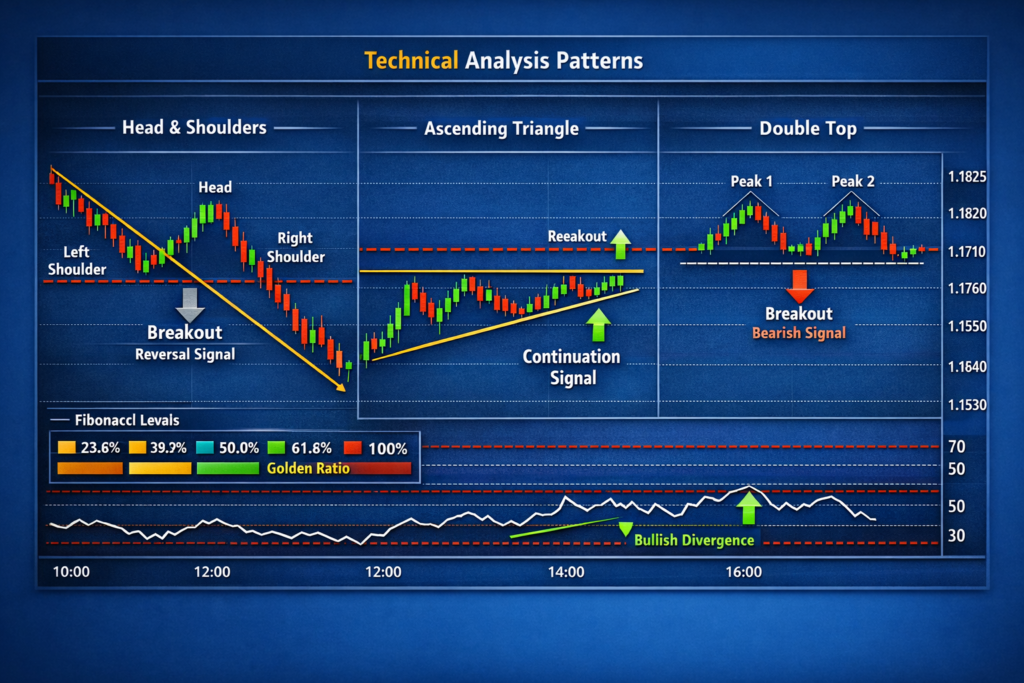
How to Choose the Right Indicators for Your Strategy
Not every indicator suits every trader. Your choice depends on your trading style, time horizon, and risk tolerance.
Scalpers
- Prefer fast-reacting indicators like Stochastic Oscillator, EMA, and ATR
- Focus on short timeframes (M1, M5)
Day Traders - Use RSI, MACD, and Bollinger Bands for intraday setups
- Often combine indicators with news events
Swing Traders - Rely on SMA, Fibonacci Retracement, and MACD
- Trade over days or weeks, focusing on trend strength and pullbacks
Position Traders - Use long-term indicators like 200 MA, MACD, and Fundamental Analysis
- Focus on macroeconomic trends and interest rate cycles
The key is to test combinations that match your personality and strategy. You can explore more setups in our Technical Analysis section and refine your mindset in the Psychology category.
How to Use Indicators Effectively
✅ Combine Indicators
Use 2–3 indicators together for confirmation. Example: RSI + MA + MACD.
✅ Avoid Overloading
Too many indicators = analysis paralysis.
✅ Match to Strategy
Scalpers use fast indicators (Stochastic, EMA). Swing traders prefer slower ones (SMA, MACD).
✅ Backtest Your Setup
Test your indicator combo on historical data before going live.
Combining the best technical indicators for forex trading can help reduce false signals and improve trade accuracy.
External Resources
- Forex Factory Calendar — track economic events
- Investopedia: Technical Indicators (investopedia.com in Bing) — deep dive into indicator types
- BIS Statistics — global interest rate data
Internal Links
- Technical Analysis — explore chart patterns and indicator strategies
- Psychology — learn how to manage emotions when indicators give conflicting signals
Conclusion
The best technical indicators for forex trading help you analyse price action, confirm trends, and manage risk. By combining the right tools and matching them to your strategy, you’ll trade with more clarity and confidence.
By mastering the best technical indicators for forex trading, you’ll gain a clearer view of price action and make smarter decisions.
In the next article, we’ll explore how to build a complete forex trading strategy using indicators, risk management, and psychology.