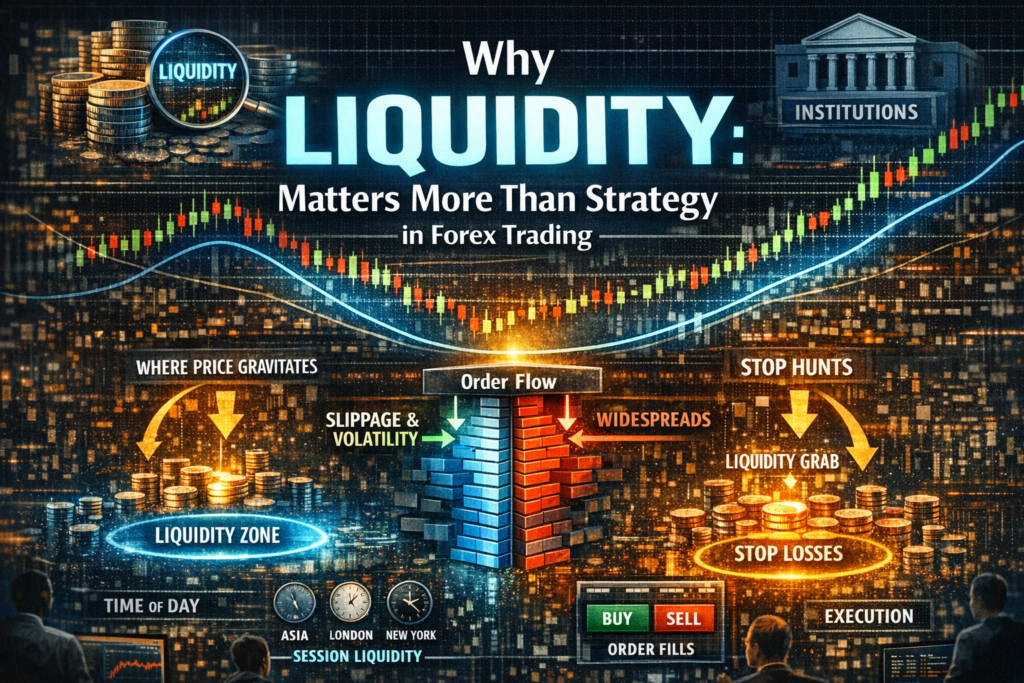
Forex liquidity vs strategy: Most traders obsess over strategy — entries, indicators, patterns, and backtests. But in the real world of Forex trading, liquidity quietly determines whether any strategy can actually work. Liquidity is the engine that keeps the market moving. Without it, even the most sophisticated trading system collapses under slippage, widening spreads, and unpredictable execution.
Understanding liquidity isn’t optional. It’s the difference between trading in a smooth, efficient market and fighting against a chaotic, unstable one.
What Liquidity Really Means in Forex
Liquidity refers to how quickly and efficiently a currency pair can be bought or sold without causing major price changes. A highly liquid market has:
- Tight spreads
- Fast execution
- Deep order books
- Stable price movements
The Forex market is the most liquid financial market in the world, but liquidity isn’t constant. It fluctuates by session, news events, and currency pair. That’s why forex liquidity vs strategy mastering knowledge is a must have in the trading world.
Forex Liquidity vs Strategy: Why Liquidity Matters More Than Your Strategy
1. Liquidity Determines Your Real Entry and Exit Price
Your strategy may tell you to enter at 1.2500 — but if liquidity is thin, you might get filled at 1.2508 or worse. That difference is slippage, and it destroys profitability.
A strategy that looks perfect on paper can fail in live markets simply because it cannot execute at intended prices.
2. Low Liquidity Creates Volatility That Breaks Technical Setups
During low‑liquidity periods (Asian session, holidays, pre‑news), price often behaves erratically:
- Random spikes
- Fake breakouts
- Sudden reversals
- Gaps between candles
These movements aren’t driven by real market sentiment — they’re caused by a lack of orders. No strategy can reliably predict this behavior.
3. Spreads Widen When Liquidity Drops
Even major pairs like EUR/USD can see spreads widen dramatically during:
- Market open/close
- Major news releases
- Unexpected geopolitical events
A strategy that depends on tight spreads becomes unprofitable the moment liquidity dries up.
4. Liquidity Dictates Risk More Than Indicators Do
Most traders think risk comes from bad analysis. In reality, risk often comes from:
- Not being able to exit a losing trade
- Getting slipped on stop losses
- Having stops triggered by liquidity spikes
- Being trapped during news volatility
Liquidity is the invisible force that determines whether your risk management actually works. Learn More
5. Institutional Traders Prioritize Liquidity Above All Else
Banks, hedge funds, and market makers don’t obsess over RSI or MACD. They focus on:
- Market depth
- Order flow
- Liquidity pools
- Volume concentration
They know that liquidity is the foundation of every profitable trade. Retail traders who ignore this are playing a different — and much harder — game. They don’t understand why forex liquidity vs strategy is a fundamental skill to master in forex trading.
When Forex Liquidity Is Highest
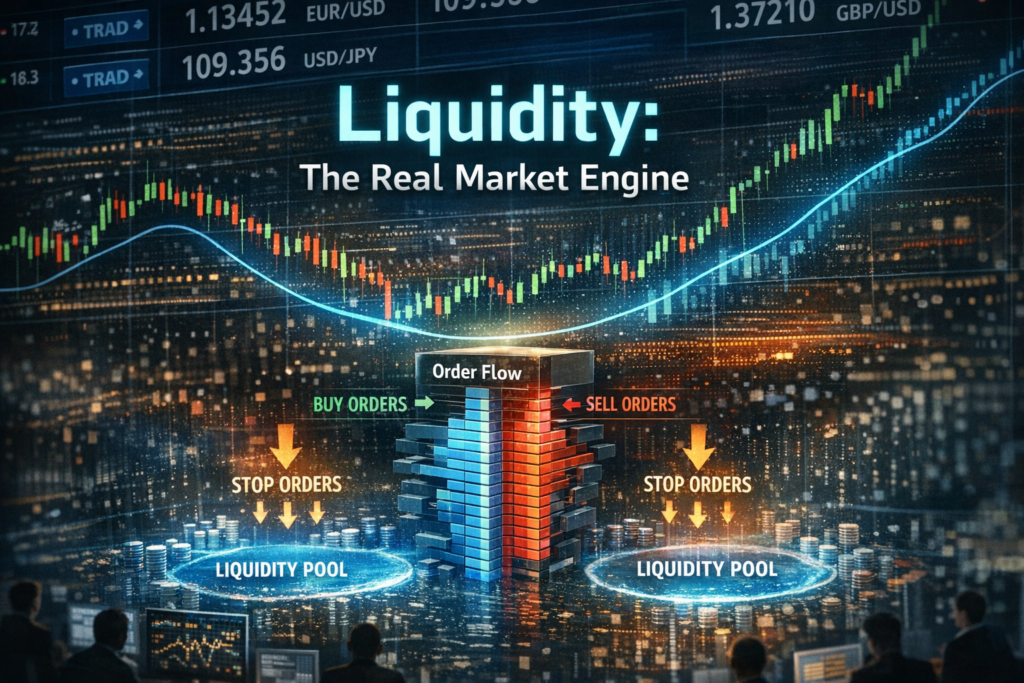
Liquidity peaks when major financial centers overlap:
London–New York Overlap (Most Liquid Period)
- Highest volume
- Tightest spreads
- Most reliable price action
This is when most professional traders operate.
London Session
- Strong liquidity
- Clear trends
- Institutional participation
New York Session
- High liquidity, especially early
- Major news releases
Trading during these periods gives your strategy the best chance to perform as intended.
When Liquidity Is Lowest
Avoid or be extremely cautious during:
- Asian session (except JPY pairs)
- Market open on Monday
- Market close on Friday
- Holidays
- Pre‑news uncertainty
- After major news spikes
Low liquidity means unpredictable price behavior — the enemy of consistent trading.
How to Make Liquidity Work for You
Here are practical steps to improve your trading immediately:
- Trade major pairs (EUR/USD, GBP/USD, USD/JPY)
- Focus on high‑liquidity sessions
- Avoid trading during low‑volume periods
- Use limit orders to control slippage
- Check spreads before entering
- Reduce position size during news events
- Track liquidity patterns in your trading journal
A simple strategy executed in high‑liquidity conditions will outperform a complex strategy executed in poor conditions. Learn more
Final Thoughts
Liquidity is the foundation of Forex trading. Strategies matter — but only after liquidity is accounted for. When you trade in high‑liquidity environments, you get:
- Better entries
- More predictable price action
- Lower spreads
- Less slippage
- More reliable risk management
If you want consistent results, stop obsessing over finding the “perfect strategy.” Start focusing on when and where you trade — because liquidity is the real edge. You must have a balance knowledge about forex liquidity vs strategy.